



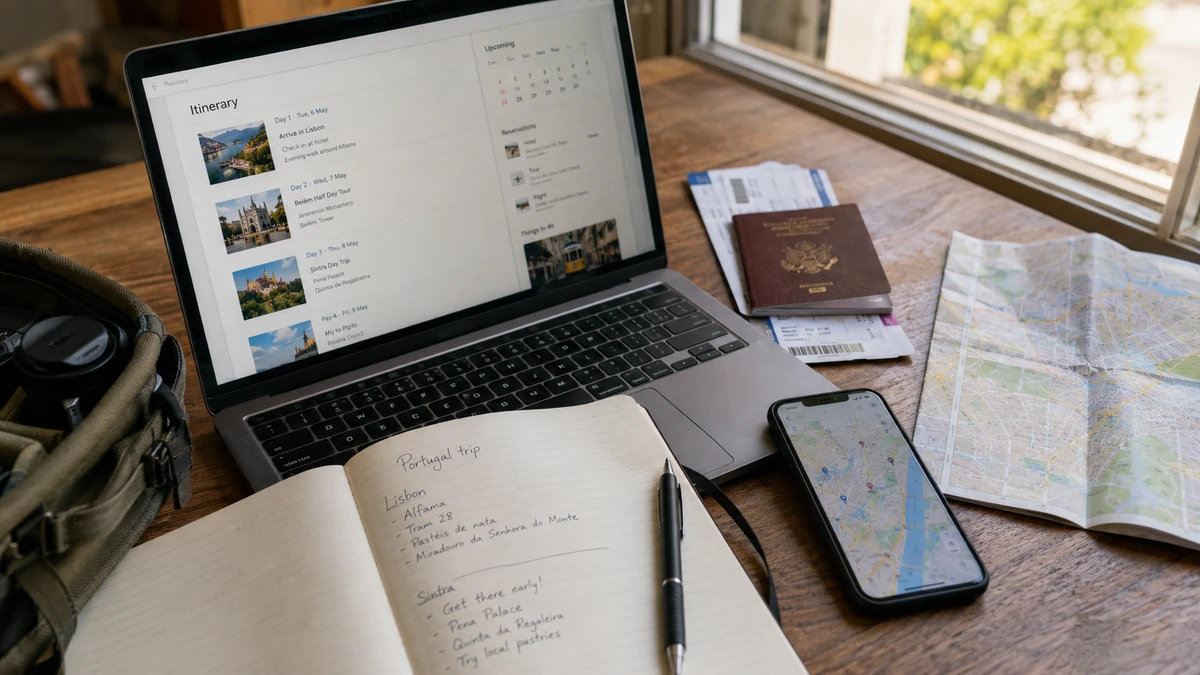
Travel planning became much easier for me when I stopped treating it as one enormous task.
I used to jump between cheap flights, hotel tabs, Google Maps pins, restaurant lists, screenshots, and half-finished itineraries. I was collecting plenty of information, but I was not always making better decisions. The real problem was knowing what to decide first.
My planning process now follows a simple order:
trip style → available time → realistic budget → destination → flights → neighborhood → accommodation → route → itinerary → reservations → practical setup → backup plan
That order has saved me from several mistakes. I have booked a cheap hotel that stopped looking cheap once I added daily transport costs. I have planned walking routes that looked easy on a map but felt very different after hours outside in the heat. I have also treated arrival days like normal sightseeing days and regretted it before dinner.
This guide covers the travel planning system I now use for domestic and international trips, including budgeting, flights, accommodation, itinerary planning, travel planning apps, transportation, reservations, mobile data, documents, and the parts of a trip I deliberately leave unplanned.
My Travel Planning Process at a Glance
| Stage | What I Work Out | Why It Matters |
|---|---|---|
| Trip style | What I actually want from the trip | Stops me choosing a destination for the wrong reason |
| Available time | Number of genuinely usable days | Prevents overpacked itineraries |
| Budget | Total trip cost | Shows what I can realistically afford |
| Destination | Place and season together | Connects weather, crowds, cost, and interests |
| Flights | Best overall journey | Avoids poor arrival times and hidden costs |
| Neighborhood | Best base for my itinerary | Often matters more than the hotel itself |
| Accommodation | Location, cost, comfort, flexibility | Balances convenience against price |
| Route | Logical order of cities or neighborhoods | Cuts unnecessary backtracking |
| Itinerary | A realistic daily plan | Turns saved places into a workable trip |
| Reservations | What genuinely needs advance booking | Protects important experiences |
| Practical setup | Money, data, documents, insurance | Prevents avoidable problems |
| Backup plan | Alternatives for disruption | Stops one problem ruining the day |
I Decide What Kind of Trip I Want Before Choosing Where to Go
I did not always start here.
For years, I saw an attractive destination or unusually cheap flight and immediately began building a trip around it. Sometimes that worked. Other times I discovered that I had planned the wrong type of vacation simply because the initial airfare looked good.
Now I start with the experience.
Do I want museums and food? Long walks through neighborhoods? Beaches? Hiking? A road trip? One comfortable base or several cities? Am I happy renting a car? Do I want early starts, or do I want a trip where breakfast can take an hour?
These questions quickly remove destinations that may look appealing but do not fit the trip I actually want.
They also stop airfare from controlling the whole decision.
A $300 flight to an expensive destination can still produce a more costly vacation than a $500 flight somewhere with affordable accommodation, food, and transportation.
The flight price is only one part of the calculation.
I Count Usable Days, Not Just Vacation Days
A seven-day trip does not always give me seven useful travel days.
That was one of my earliest planning mistakes.
An overnight flight, immigration, baggage collection, airport transfers, check-in, jet lag, and an early departure can remove a surprising amount of usable time.
Intercity travel matters too.
A train journey may take only three hours, but checking out, reaching the station, waiting, traveling, finding the next hotel, and checking in can consume most of the middle of the day.
I once treated a hotel-change day like an ordinary sightseeing day because everything fitted neatly into my spreadsheet. Technically, the itinerary worked. In reality, I spent much of the day watching the clock.
Now I block out these days first:
- arrival day
- departure day
- hotel-change days
- long-distance transportation
- fixed tours or events
Only then do I calculate how much time I actually have for sightseeing.
That small change made my itineraries considerably more realistic.
I Work Out What the Trip Will Really Cost

“Set a travel budget” sounds sensible, but it is not particularly useful unless the budget reflects what actually happens after the plane lands.
I divide my expected spending into categories before booking the expensive parts of a trip.
| Expense | What I Include |
|---|---|
| Flights | Fare, baggage, seat selection, airport transportation |
| Accommodation | Room rate, taxes, resort or destination fees |
| Local transport | Metro, buses, taxis, rideshare, fuel, parking |
| Intercity travel | Trains, coaches, ferries, domestic flights |
| Food | Meals, coffee, drinks, snacks |
| Activities | Admission, tours, day trips, reservations |
| Connectivity | eSIM, SIM card, or roaming |
| Money | ATM and foreign transaction fees |
| Documents | Visa or travel authorization where required |
| Insurance | Relevant trip and medical cover |
| Small extras | Lockers, luggage storage, laundry, tips |
| Buffer | Unexpected changes |
The small expenses were the ones I underestimated most often.
An airport transfer did not look serious on its own. Neither did coffee, luggage storage, a metro ticket, an ATM fee, or a local accommodation tax.
Put enough of those together and they start taking money away from the restaurants and activities I actually care about.
I also keep a separate buffer rather than planning to spend the entire budget.
It gives me room for an unexpected taxi, a missed connection, a changed train, or another small problem without immediately having to cut something from the trip.
I Choose the Destination and Season Together
I no longer think about a destination separately from the month I plan to visit.
Weather can change almost everything.
Extreme heat affects how much walking I enjoy. Heavy rain can change hiking or beach plans. Winter may bring reduced daylight, seasonal closures, ferry changes, or difficult road conditions.
Major festivals and holidays can also turn an otherwise affordable city into an expensive one.
Before committing, I usually check:
- typical seasonal conditions
- daylight hours
- peak or shoulder season
- major local holidays
- festivals and events
- seasonal closures
- expected crowd levels
- accommodation prices
Sometimes the season that looks best in photographs is also the busiest and most expensive.
On other trips, shoulder season has given me less predictable weather but noticeably better hotel prices and smaller crowds.
I stopped looking for a universal “best time to visit.” The better question is which compromises matter least for the trip I want.
I Check Entry Rules Before Paying for a Nonrefundable Trip
International travel is where I become much less relaxed about assumptions.
Passport-validity rules, visas, electronic travel authorizations, permitted lengths of stay, and entry requirements can change.
For international trips from the United States, I use the U.S. Department of State International Travel Checklist to check destination-specific travel advisories, entry and exit requirements, visa information, passport validity, local laws, and embassy details.
Before committing serious money, I normally confirm:
- passport expiration date
- destination-specific passport validity requirements
- visa requirements
- electronic travel authorizations
- permitted length of stay
- onward-travel requirements where applicable
- entry restrictions
- travel advisory information
I do this early.
Discovering a passport problem three days before departure is a very different problem from discovering it three months before departure.
I Check Health Requirements While There Is Still Time to Act
Health preparation used to sit near the bottom of my checklist.
That does not work particularly well for destinations where vaccinations, medication, or other precautions need advance planning.
I now check the CDC Travelers’ Health destination information early in the process. CDC advises travelers to review destination-specific risks and, where relevant, arrange a healthcare or travel-health appointment several weeks before departure.
The amount of preparation varies enormously.
For some trips, it involves little more than checking routine information and packing medication properly. Others require more thought.
The important lesson for me was simply not to leave this until the suitcase was already open on the bed.
I Research Flights Before Building the Detailed Itinerary

Flights affect far more than travel day.
They can decide how much usable time I have at the beginning and end of a trip.
I compare:
- departure time
- arrival time
- nonstop versus connecting routes
- connection length
- total travel time
- baggage rules
- airport location
- airport-to-hotel transportation
- cancellation and change conditions
I often use flight-search tools to understand the available routes and typical fares, then check the airline directly before booking.
The lowest fare is not always the cheapest journey.
A late-night arrival may mean an expensive taxi because public transportation has stopped. A 6 a.m. departure can mean a very early transfer or an airport hotel.
A long connection can effectively remove another day from the trip.
I eventually learned to compare the whole journey, not just the number beside the flight.
For flights involving U.S. airlines, I also use the U.S. Department of Transportation Airline Cancellation and Delay Dashboard when I want to compare airline commitments for controllable delays and cancellations.
I Choose the Neighborhood Before I Choose the Hotel
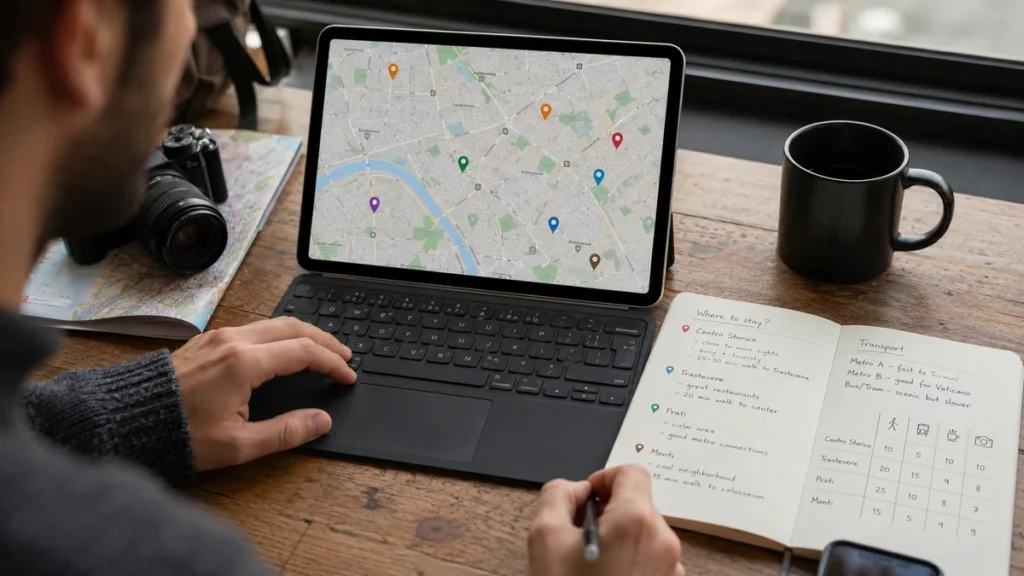
This was one of the biggest improvements I made to my travel planning.
I used to search for hotel deals across an entire city.
Now I decide where I want to stay first.
I open Google Maps and mark:
- major attractions
- neighborhoods I want to explore
- restaurants or food areas
- metro or train stations
- airport connections
- day-trip departure points
- areas I may visit in the evening
Then I look for a base that makes those plans easier.
A cheaper room is not much of a bargain if I spend more money and an extra 90 minutes every day commuting across the city.
I also inspect the streets immediately around potential accommodation.
A hotel can look central on a booking platform but still sit beside a noisy highway, at the top of a steep hill, or farther from useful public transport than I expected.
On several trips, spending slightly more for location gave me better value than spending the same amount on a nicer room farther away.
I Map Places Before Turning Them Into an Itinerary
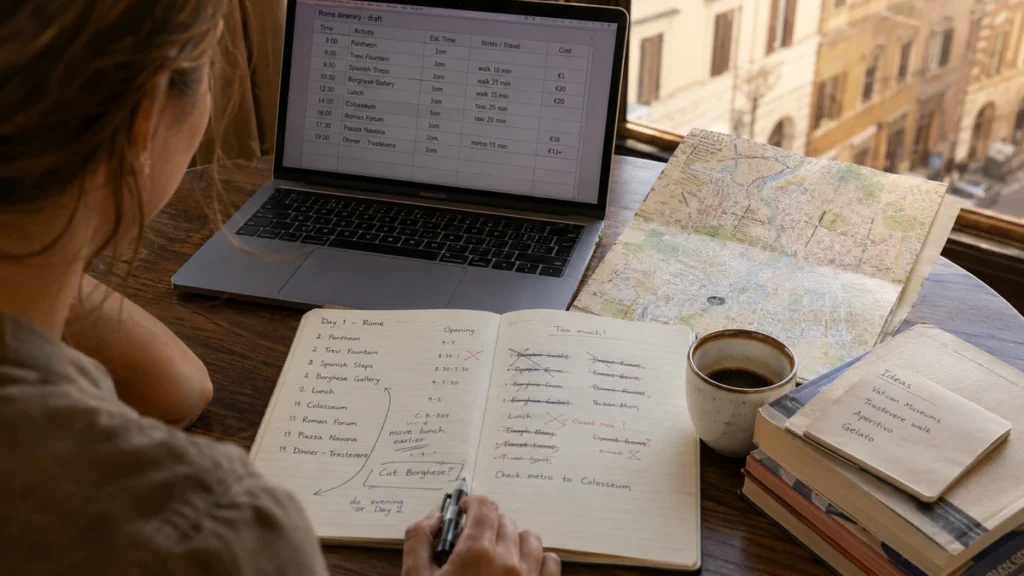
Saving attractions is not the same as planning them.
At one stage, I could easily save 30 or 40 places in a city without noticing that they made very little geographical sense together.
Now I pin places first and look for clusters.
The map helps me see:
- which attractions belong on the same day
- where restaurants fit naturally
- which areas need public transportation
- where I am backtracking
- which supposedly nearby places are actually inconvenient
This matters even more in cities divided by rivers, steep hills, large parks, limited crossings, or complicated transit lines.
The same principle applies to multi-city travel.
Before adding another stop, I check how much time reaching it will really take. A destination may be geographically close yet awkward to reach without several changes.
Discovery tools help me identify possible routes.
For important journeys, I still verify schedules and booking conditions with the actual transport operator.
I Build the Itinerary Around Anchor Activities
I used to plan days almost hour by hour.
The itineraries looked excellent before the trip and increasingly ridiculous once I started following them.
Now I normally choose one or two anchor activities for each day.
A day might look like:
major morning attraction → lunch area → flexible afternoon → evening neighborhood
The anchor may be a museum reservation, tour, landmark, event, or another activity I genuinely care about.
Everything else has more room to move.
When planning a day, I consider:
- opening hours
- timed-entry tickets
- likely queues
- realistic visit duration
- walking distance
- public transportation
- meal breaks
- weather
- daylight
- my likely energy level
This gives me a better trip than calculating the maximum number of attractions I can theoretically fit between breakfast and dinner.
The Step Most Travel Plans Miss: I Stress-Test the Day
Once an itinerary looks finished, I try to prove that it does not work.
This became one of the most useful parts of my planning process.
I mentally run through the day:
hotel → transportation → queue → attraction → next journey → lunch → second attraction → return
Then I look for weak points.
Could I still make the afternoon reservation if lunch takes longer?
Am I crossing the same part of the city twice?
Have I allowed time to find the right platform or entrance?
Does an attraction’s closing time make the order unrealistic?
Is a long walking day scheduled immediately after an overnight flight?
Have I left any time to simply stop?
If the day only works when every train arrives on time, every meal is fast, and I never get tired, the itinerary does not really work.
I remove something.
That still feels uncomfortable sometimes. I want to see everything too.
But the trips I enjoyed most were rarely the ones where I managed to tick the most boxes.
I Decide What Is Worth Booking in Advance
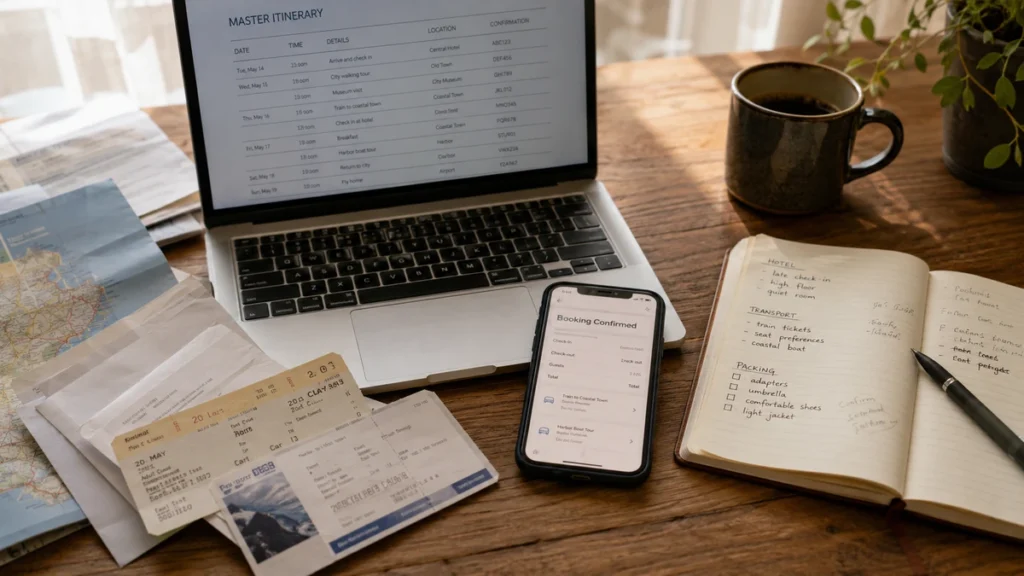
Advance reservations give me certainty.
Too many of them remove flexibility.
I divide plans into two groups.
| I Usually Book Early | I Often Leave Flexible |
|---|---|
| Flights | Casual meals |
| Accommodation | Cafés |
| Limited-seat trains | Neighborhood walks |
| Timed-entry attractions | Smaller attractions |
| Popular tours | Shopping |
| Special events | Weather-dependent activities |
| A restaurant I genuinely care about | Most everyday dinners |
The question I ask is simple:
Would missing this meaningfully change the trip?
If the answer is yes and availability is limited, I book it.
If the answer is no, I usually prefer flexibility.
A fully reserved schedule became surprisingly annoying on trips where I found a neighborhood I wanted to explore for another two hours but had to leave because of a booking I no longer cared about.
I Also Decide What Not to Book
This became almost as important as deciding what to reserve.
There is a temptation during travel planning to remove every uncertainty before leaving home.
I learned that some uncertainty improves the trip.
I rarely need to pre-book every lunch, ordinary museum, café, shopping stop, or neighborhood walk.
Leaving space gives me room for:
- bad weather
- tired legs
- local recommendations
- a restaurant I notice while walking
- an attraction that takes longer than expected
- somewhere I simply enjoy more than expected
A flexible itinerary is not an unfinished itinerary.
It is one that can respond to the destination.
I Plan Arrival Day Differently From Every Other Day
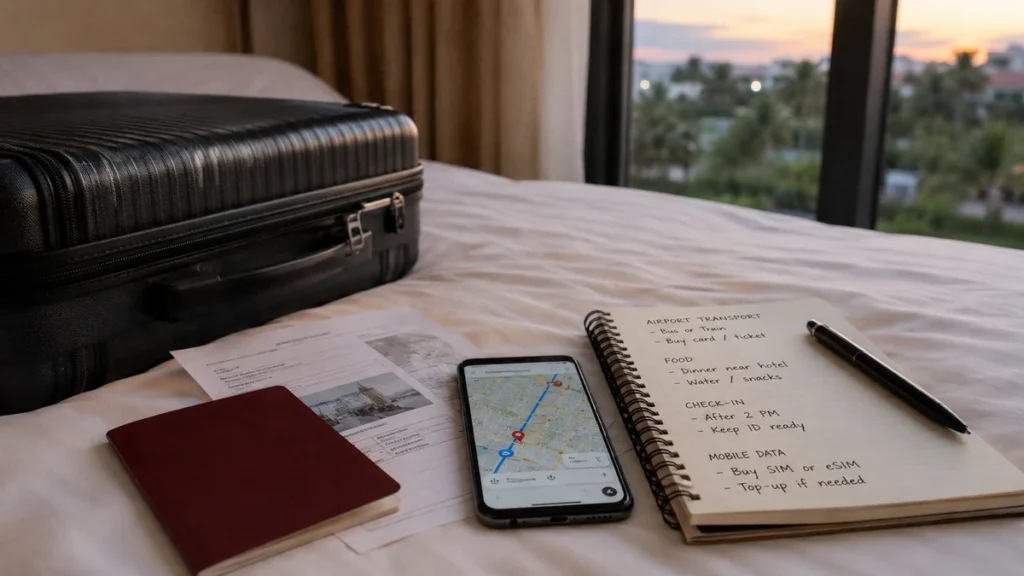
Arrival day used to expose how optimistic my itineraries were.
I saw a 2 p.m. landing time and somehow translated it into “free afternoon.”
Immigration, baggage, airport navigation, transportation, check-in, finding food, and simple tiredness often had other plans.
My arrival-day itinerary is now deliberately simple:
airport → accommodation → food → short walk → essentials → sleep
Before I fly, I know:
- how I plan to leave the airport
- approximate journey time
- hotel check-in arrangements
- how I will get mobile data
- where I can eat if I arrive late
- how to find my accommodation offline
Anything else is a bonus.
A calm first evening has improved far more trips than squeezing in one additional attraction.
I Plan Local Transportation Before Arriving
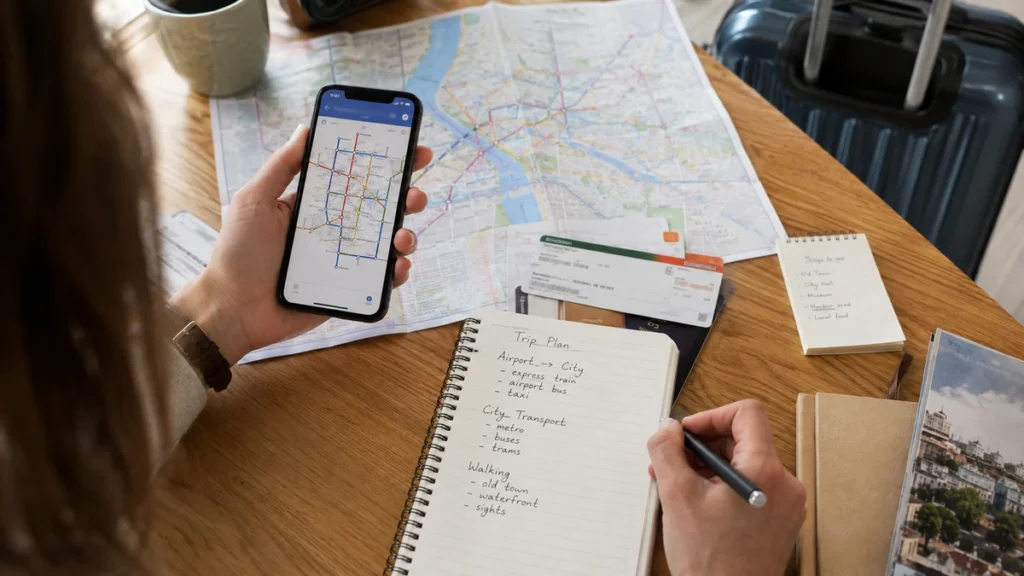
I do not memorize an entire metro network before traveling, but I want to understand the basics.
I normally check:
- airport transportation
- public transport payment methods
- useful metro or rail lines
- late-night services
- major stations
- taxis or rideshare
- rental-car requirements
- parking where relevant
Rental cars need a proper cost comparison.
The headline daily rate tells me very little if I have not included fuel, tolls, parking, insurance, and the inconvenience of driving in an unfamiliar city.
In other destinations, a car can save so much time that paying more is worthwhile.
The right choice depends on the route.
I Keep One Master Version of the Trip
My old planning system scattered information everywhere.
Some reservations were in email. Others were screenshots. Restaurants lived in Google Maps. Train times were in my notes. Another traveler had the hotel confirmation.
I now keep one master itinerary.
It includes:
- flight details
- accommodation addresses
- booking references
- transport reservations
- important tickets
- fixed opening times
- daily neighborhoods
- useful transport notes
The specific tool matters less than knowing where the current version of the trip lives.
I also make essential confirmations available offline.
Landing without mobile data taught me that lesson fairly quickly.
The Travel Planning Apps I Actually Use
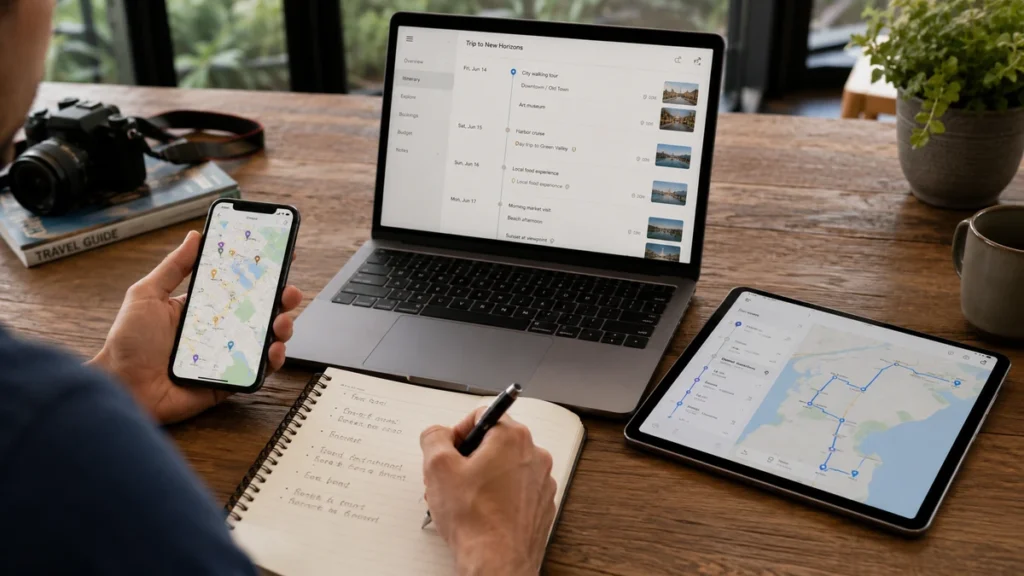
I do not think there is one perfect travel planning app.
I tried forcing everything into a single planner before. It looked organized until I needed another app for maps, another for flights, and another for transportation.
A small collection of tools works better for me because each one solves a different problem.
| Travel Planning App | What I Use It For | Best Part | Limitation |
|---|---|---|---|
| Google Maps | Saving places and organizing days geographically | Makes location mistakes obvious | Not a complete itinerary planner |
| Wanderlog | Building a day-by-day trip plan | Combines itinerary and map planning | More structure than I need for simple trips |
| TripIt | Organizing confirmed bookings | Keeps reservation details together | Better after booking than during inspiration |
| Rome2Rio | Researching transport between destinations | Shows several ways to get from A to B | I still verify final schedules |
| Skyscanner | Early flight research | Makes route and fare comparison easy | Final conditions need checking |
| Google Sheets | Budgeting and custom organization | Flexible and easy to share | Requires manual input |
Google Maps Is My Starting Point for Most Trips
Google Maps is the planning tool I probably use most.
I save attractions, restaurants, cafés, viewpoints, stations, accommodation areas, and possible backup activities.
Once those pins appear on the map, the trip begins making more sense.
This is often where I notice that an itinerary I thought was efficient is not efficient at all.
Three places may all be described as “central,” yet visiting them in one day can mean crossing the city repeatedly.
I also stopped treating every saved pin as a commitment.
My saved places now fall roughly into three groups:
high priority → nearby if I have time → backup
That keeps the map useful instead of turning it into another stressful checklist.
Wanderlog Works Better When the Trip Becomes Complicated
Wanderlog becomes more useful once I move from collecting ideas to building a daily itinerary.
The map-and-itinerary combination is the feature I value most.
It makes it easier to see whether I am placing attractions together logically, especially on longer city trips or multi-stop itineraries.
I also find collaborative planning useful when more than one person is making decisions.
Instead of restaurant links disappearing into a group chat, they can sit inside the same trip plan.
For a simple weekend trip, Wanderlog can feel like more structure than I need.
For a longer itinerary, it becomes much more useful.
TripIt Helps After the Reservations Start Accumulating
TripIt solves a different problem.
Once flights, accommodation, trains, rental cars, and tours are booked, confirmation details start spreading across my inbox.
That is when an itinerary organizer becomes valuable.
I see TripIt primarily as an organization tool rather than an inspiration tool.
I am not using it to decide what neighborhood to explore.
I am using it so I do not have to search through old emails while standing at a station.
Rome2Rio Helps Me Understand How Places Connect
Rome2Rio is useful during the stage when I know where I want to go but not how practical the route is.
It can help me identify possible combinations of:
- trains
- buses
- ferries
- flights
- driving
This is particularly useful before I add another destination to a multi-city itinerary.
A place can look close on a map yet require an awkward connection that costs half a day.
I use Rome2Rio for research rather than treating it as the final timetable.
Important schedules still get checked with the railway, bus company, ferry operator, or airline.
Skyscanner Helps Me Understand Flight Options
Skyscanner is most useful to me before the itinerary becomes fixed.
I use it to compare routes, dates, airlines, and approximate fares.
When my destination or dates have some flexibility, this kind of comparison can expose alternatives I had not considered.
I still avoid choosing a destination solely because the airfare looks cheap.
Hotels, food, transportation, and activities can easily erase the savings once I arrive.
Before paying, I also compare the airline’s own fare and booking conditions.
Google Sheets Still Works Surprisingly Well
A spreadsheet is not exciting, but it remains one of my most useful planning tools.
For longer trips, I use it for things such as:
- travel budget
- actual spending
- hotel comparisons
- booking references
- dates
- links
- transportation costs
- shared expenses
The biggest advantage is flexibility.
I can organize it around the trip rather than organize the trip around an app.
For a weekend away, I rarely bother.
For a two-week multi-city journey, it can be extremely useful.
Which Travel Planning App Is Best?
I do not think there is one answer.
It depends on the problem.
| If I Need To… | Tool I Usually Use |
|---|---|
| Save attractions and restaurants | Google Maps |
| See which places are close together | Google Maps or Wanderlog |
| Build a daily itinerary | Wanderlog |
| Plan with other travelers | Wanderlog or Google Sheets |
| Organize confirmed reservations | TripIt |
| Research transport between destinations | Rome2Rio |
| Compare flight options | Skyscanner |
| Track a detailed budget | Google Sheets or Wanderlog |
| Keep a map available offline | Google Maps |
| Verify a train or flight schedule | Official operator |
That final row matters most.
Travel planning apps are good at discovery, comparison, organization, and itinerary building.
They are not the final authority for information that could derail a trip.
If a train matters, I check the train operator.
If an attraction needs a reservation, I check the attraction.
If a flight matters, I check the airline.
If an entry rule matters, I check the government source.
My Simple Travel Planning App Setup
After trying more complicated systems, I keep returning to this:
Google Maps for locations and saved places.
Wanderlog or Google Sheets for the main itinerary.
TripIt when confirmed bookings start becoming difficult to manage.
Rome2Rio for transportation research.
Skyscanner for early flight comparison.
Official websites for anything that needs to be correct on the day I travel.
Using several tools sounds less efficient than finding one all-in-one trip planner.
In practice, it has been simpler.
Each one has a job.
I Sort Out Money and Mobile Data Before the Flight
Two things I dislike sorting out while tired at an airport are money and phone plans.
I handle both before departure when possible.
For money, I check:
- foreign transaction fees
- ATM charges
- card acceptance
- local cash requirements
- backup payment methods
- exchange rates
I carry more than one payment option.
Having my entire trip dependent on a single card never felt sensible.
For connectivity, I compare:
- international roaming
- eSIMs
- physical SIM cards
- Wi-Fi availability
I also download the arrival area for offline use and save the hotel address separately.
That preparation has been far more useful than spending another hour researching restaurants.
I Pack for the Trip I Actually Planned

My packing list now starts with the itinerary.
A walking-heavy city trip needs reliable shoes.
A wet season changes what goes near the top of the bag.
A budget airline changes how much luggage makes sense.
A road trip has completely different packing limits.
For domestic air travel in the United States, I check the current identification requirements through the Transportation Security Administration’s official guidance. REAL ID enforcement began on May 7, 2025, and travelers aged 18 or older need a REAL ID-compliant state credential or another acceptable form of identification, such as a passport, at TSA checkpoints.
I check current requirements rather than assuming the rules are the same as they were on my last trip.
I Always Leave Room for Plan B
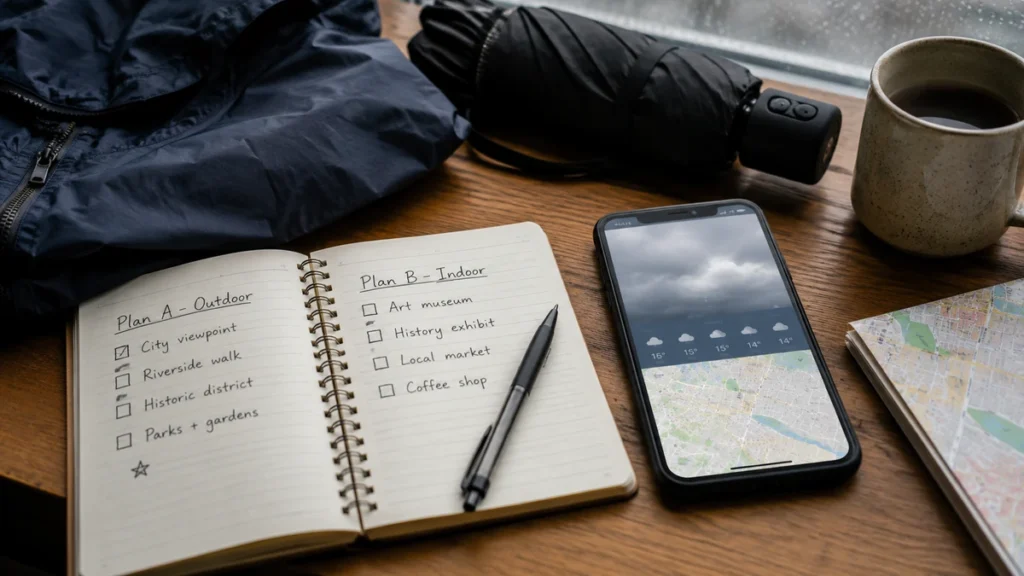
Weather, delays, closures, tiredness, and changing my mind are normal parts of travel.
I no longer create a second complete itinerary as backup.
I just keep a few realistic alternatives.
That might mean:
- an indoor attraction if it rains
- a shorter walking route
- a flexible afternoon
- another restaurant nearby
- an alternative train
- an activity that does not need a reservation
The goal is not to predict every problem.
It is to stop one problem deciding the whole day.
How I Use AI for Travel Planning
AI has become useful during the planning process, but I give it a limited job.
I use it to:
- organize messy research
- compare possible routes
- group attractions by area
- brainstorm destinations
- turn a long list into a rough itinerary
- identify questions I may have forgotten to research
I do not treat an AI-generated itinerary as proof that a trip works.
Anything that can change still gets checked.
That includes:
- opening hours
- ticket prices
- transport schedules
- visa rules
- seasonal closures
- reservation requirements
- local regulations
AI is useful for organizing possibilities.
It is not where I want to discover, after arriving, that a train stopped running months ago.
My Practical Travel Planning Timeline
I use this as a flexible framework rather than a rule.
| Before Departure | What I Usually Handle |
|---|---|
| 3–6+ months | Destination, broad budget, passport and entry research |
| 2–4 months | Flights and main accommodation |
| 1–3 months | Route, intercity transport, major attractions |
| 2–6 weeks | Detailed itinerary, insurance, health preparation |
| 1–2 weeks | Local transport, money, mobile data, restaurant ideas |
| Final week | Weather, packing, reservation checks |
| 24–48 hours | Check-in, downloads, arrival transport, offline documents |
Peak seasons, major festivals, cruises, limited accommodation, and highly popular attractions can require much earlier planning.
A spontaneous weekend trip may need very little of this.
The timeline is supposed to remove stress, not become another source of it.
Travel Planning Mistakes That Changed How I Travel
I Chose Cheap Accommodation in the Wrong Area
The room saved money.
The location did not.
Long journeys and extra transportation costs made me wish I had paid slightly more to stay closer to where I actually wanted to spend my time.
I Trusted Map Distance Too Much
A route can look short while ignoring steep streets, awkward crossings, indirect public transport, crowds, or heat.
Now I judge distance in context.
I Planned Too Many “Efficient” Days
Grouping nearby attractions is useful.
Trying to visit all of them just because they are nearby is not.
Three museums within six blocks are still three museums.
I Scheduled Too Many Meals
A few special restaurant reservations were completely worth organizing.
Others interrupted better evenings.
I now book meals selectively.
I Treated Arrival Day Like Free Sightseeing Time
It rarely was.
Once I stopped expecting arrival day to behave like a normal day, trips started more smoothly.
I Tried to Fill Every Empty Hour
This was probably my biggest planning mistake.
An empty two-hour block used to look inefficient.
Now it looks valuable.
That space has given me long lunches, unexpected markets, quiet streets, coffee stops, better sunsets, and enough time to notice where I actually am.
My Final Travel Planning Checklist
Before departure, I want to know that I have covered:
- destination and dates
- realistic number of usable days
- total travel budget
- passport validity
- visa or entry requirements
- relevant health preparation
- flights
- baggage rules
- accommodation
- the right neighborhood
- airport transportation
- intercity transportation
- important attraction reservations
- realistic daily itinerary
- travel time between major stops
- local public transportation
- payment methods
- travel insurance where appropriate
- mobile data
- offline maps
- booking confirmations
- emergency information
- weather forecast
- packing requirements
- some unscheduled time
Once those pieces are in place, I stop trying to perfect the trip.
There will always be another restaurant to research, another attraction to save, and another review to read.
At some point, planning has done its job.
Frequently Asked Questions About Travel Planning
What is the first step in planning a trip?
I start by deciding what kind of trip I want, how many usable days I have, and how much I can realistically spend. Those decisions narrow the destination choices before I start paying for flights or hotels.
How far in advance should I start travel planning?
For international travel or popular peak-season destinations, I often begin several months ahead. Short domestic trips can be much more spontaneous. Major events, limited accommodation, cruises, and popular timed attractions may need earlier planning.
Should I book flights or hotels first?
I research both before committing to either. I want to know that suitable flights and accommodation are available within the same budget. For fixed dates, I normally secure whichever part is most limited or expensive while checking the cancellation conditions carefully.
How many activities should I plan each day?
One or two anchor activities usually work better for me than a packed hourly schedule. Transportation, meals, queues, weather, and simple tiredness take more time than they appear to during planning.
What are the best travel planning apps?
It depends on what I need. I use Google Maps for saving places, Wanderlog for more detailed itinerary planning, TripIt for organizing reservations, Rome2Rio for transportation research, Skyscanner for comparing flights, and Google Sheets for budgets and custom planning.
Is Wanderlog good for travel planning?
I find it most useful on longer or more complicated trips where seeing the daily itinerary alongside a map helps me avoid inefficient routes. For a simple weekend, Google Maps and a short note may be enough.
Is TripIt worth using?
It becomes more useful as the number of reservations increases. I find it more valuable on trips with several flights, hotels, transport bookings, and confirmation numbers than on a simple trip with one flight and one hotel.
How do I plan a vacation without overplanning it?
I reserve the things that are limited, expensive, or important enough that missing them would disappoint me. Ordinary meals, neighborhood walks, smaller attractions, and weather-sensitive activities stay more flexible.
Can AI plan an entire trip?
It can produce a useful starting point, but I do not use it as the final authority. I let AI help organize ideas and routes, then verify changing details such as transportation, entry rules, opening hours, prices, and reservations independently.
Final Thoughts
The biggest change in my travel planning was realizing that a good itinerary was not the one with the most reservations.
It was the one that still worked when lunch took longer, a train was late, rain arrived early, or a neighborhood turned out to be more interesting than the attraction I had planned next.
I still research heavily. My Google Maps usually ends up covered with more saved places than I could possibly visit.
I just stopped treating every saved place as an obligation.
Flights, accommodation, transportation, key reservations, documents, money, and a realistic route give me enough structure. Travel planning apps help keep those pieces organized.
Leaving some of the day unfinished gives the actual trip room to happen.
That balance has worked far better for me than any perfectly packed itinerary.