



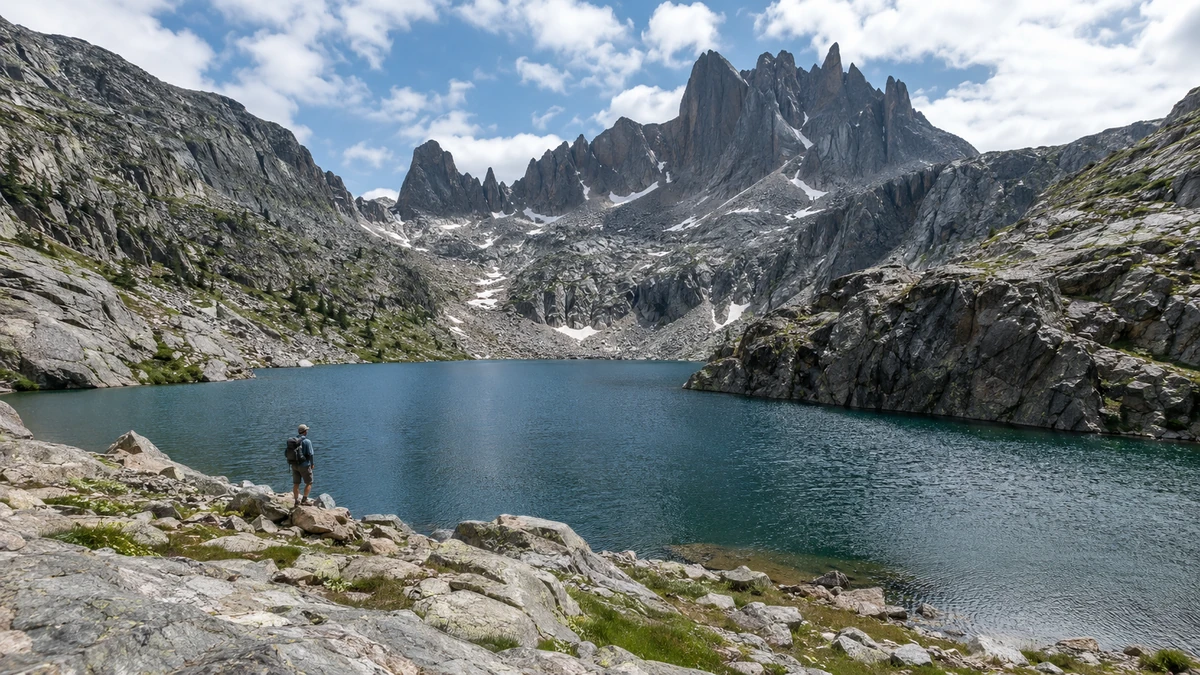
The Sky Pond hike was one of the days I looked forward to most in Rocky Mountain National Park, but it was also the hike I researched the hardest before leaving Estes Park. The mileage did not worry me nearly as much as the altitude, changing mountain weather, and the scramble beside Timberline Falls.
After hiking it, I understood why Sky Pond has such a strong reputation. The route linked Alberta Falls, The Loch, Timberline Falls, Lake of Glass, and Sky Pond into one varied day rather than making me walk for hours just to reach one viewpoint.
It was also harder than the distance alone suggested.
The altitude slowed me earlier than expected. Timberline Falls required patience rather than strength. Lake of Glass briefly fooled me into feeling as though I had finished. And once I finally reached Sky Pond, I still had several miles of descending ahead.
For a reasonably fit hiker who is comfortable using their hands on rock, I found Sky Pond genuinely worth the effort. But I would not treat it like an ordinary lake walk, especially after arriving from low elevation or when the upper trail is wet, snowy, or icy.
Sky Pond Hike at a Glance
| Detail | What to Know |
|---|---|
| Location | Rocky Mountain National Park, Colorado |
| Main starting point | Glacier Gorge Trailhead |
| Distance | Roughly 8.5–10 miles round trip depending on route and measurement |
| Elevation gain | About 1,700+ feet from Glacier Gorge |
| Glacier Gorge elevation | About 9,175 feet |
| Sky Pond elevation | Roughly 10,900 feet |
| Difficulty | Strenuous |
| Time I would allow | About 6–8 hours, including stops |
| Hardest section | Timberline Falls scramble |
| Major landmarks | Alberta Falls, The Loch, Timberline Falls, Lake of Glass, Sky Pond |
| Dogs | Not permitted on RMNP trails |
| Best general period | Summer into early fall when conditions are suitable |
| Reservation | Timed Entry + Bear Lake Road is required during designated 2026 hours |
One thing confused me before the hike: different sources give different distances for Sky Pond.
The National Park Service’s current Bear Lake Road Corridor guide lists Sky Pond at 4.2 miles one way from Glacier Gorge with 1,726 feet of elevation gain. Other trail references and GPS recordings can produce longer totals depending on the exact start, route, detours, and measurement method.
I stopped trying to plan my day around a decimal point and treated it as a roughly nine- to ten-mile high-altitude hike. That was much more useful than arguing with my GPS.
For current trail and trailhead information, I checked the official Rocky Mountain National Park Bear Lake Road Corridor guide.
Is the Sky Pond Hike Worth It?
For me, yes.
What made Sky Pond worthwhile was not simply the final lake. The route changed enough that the day kept feeling interesting.
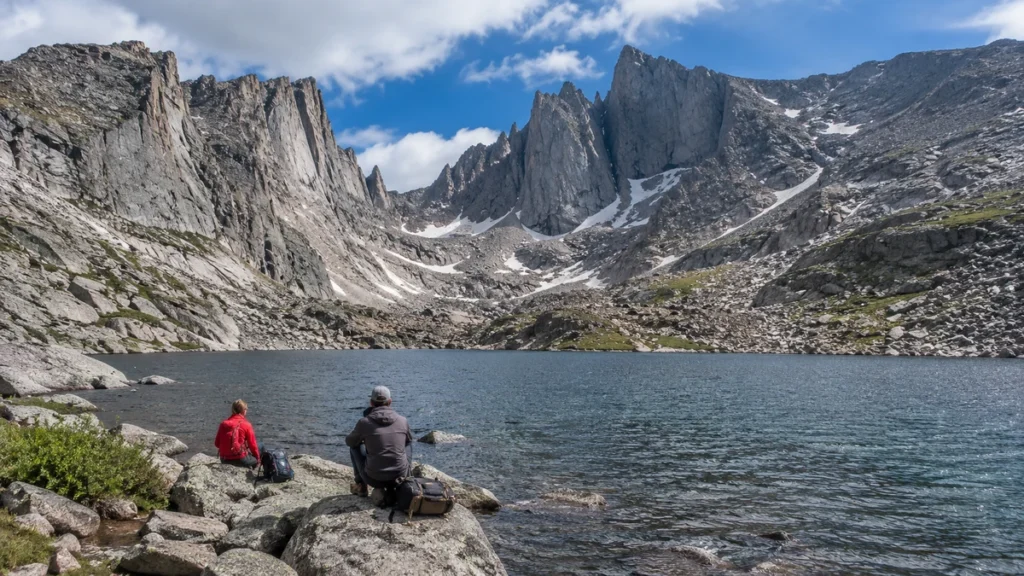
Alberta Falls came relatively early. The Loch felt like a destination of its own. Timberline Falls added a short hands-on challenge. Lake of Glass gave me a false sense of arrival. Then Sky Pond appeared beneath the Sharkstooth and the surrounding granite spires.
That progression was what I remembered afterward.
I have done hikes where most of the route felt like transportation to the final viewpoint. Sky Pond did not feel that way.
Even if weather had forced me to turn around at The Loch, I still would have considered the morning worthwhile.
That does not make Sky Pond automatically better than every easier Rocky Mountain National Park hike. Someone looking for a shorter alpine-lake day may be happier at Emerald Lake. A hiker who strongly dislikes scrambling may enjoy Mills Lake or Black Lake more.
Sky Pond suited me because I wanted a longer day with a little uncertainty and a bit of scrambling, not simply the easiest route to a beautiful lake.
How Hard Is the Sky Pond Hike Really?
Calling the Sky Pond hike “hard” is accurate, but it does not explain why it feels hard.
I found it more useful to separate the challenges.
| Challenge | How It Felt |
|---|---|
| Distance | Long but manageable |
| Normal trail | Mostly straightforward |
| Elevation gain | Steady rather than brutally steep |
| Altitude | More noticeable than expected |
| Timberline Falls | Short, steep, wet, and hands-on |
| Exposure | Limited, but enough to bother some hikers |
| Navigation | Generally straightforward in normal conditions |
| Descent | Easier aerobically but tiring |
| Snow or ice | Can make the upper route much more serious |
The biggest surprise was the altitude.
The trail begins above 9,000 feet, so I was already hiking high before reaching the more demanding upper section.
My breathing changed before my legs really started complaining. An incline that would have felt ordinary lower down required more deliberate pacing.
That is why I would not judge readiness for Sky Pond only by asking, “Can I walk nine miles?”
A more useful question is:
Can I spend most of a day hiking at high elevation, keep enough energy for the descent, and make sensible decisions if conditions change?
Can a Beginner Hike Sky Pond?
A fit beginner may be able to hike Sky Pond in good conditions, but I would not choose it as someone’s first serious mountain hike.
There are too many variables stacked together:
- a long day on foot,
- high altitude,
- sustained climbing,
- rapidly changing mountain weather,
- wet rock at Timberline Falls,
- and several miles of descent after reaching the lake.
Someone who regularly walks, runs, or trains in a gym may have enough general fitness but still find high-elevation hiking surprisingly slow.
Scrambling experience also matters.
A person who has used their hands on rocky trails before will probably view Timberline Falls differently from someone who has never moved across steep wet rock.
For me, the right mindset was not “I have to finish.”
It was “I will keep going while the trail, weather, and my body give me good reasons to continue.”
Getting to the Sky Pond Trailhead
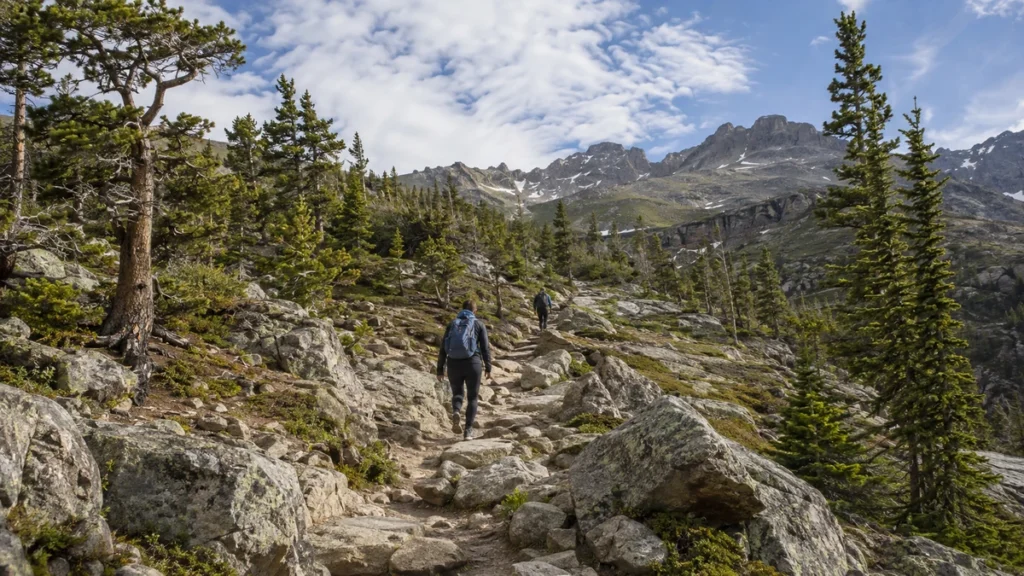
The most direct starting point for the hike is Glacier Gorge Trailhead on Bear Lake Road.
Parking was one of the things I initially planned too casually.
Glacier Gorge has limited parking, and this is one of the busiest areas of Rocky Mountain National Park. Once I saw how small the parking area was compared with the number of hikers using the corridor, I stopped treating a space there as something I could simply count on.
The alternatives made much more sense.
Glacier Gorge vs Bear Lake vs Park & Ride
| Option | Advantage | Drawback | Best For |
|---|---|---|---|
| Glacier Gorge Trailhead | Most direct start | Very limited parking | Very early arrivals |
| Bear Lake Trailhead | Larger parking area | Adds some walking | Hikers already using Bear Lake |
| Park & Ride | Removes most parking stress | Requires shuttle timing | Busy summer days |
What changed my planning was realizing that arriving early is too vague to be useful advice.
An hour that feels early on a normal vacation morning may not feel early at all on Bear Lake Road in summer.
The Park & Ride system removed much of that uncertainty.
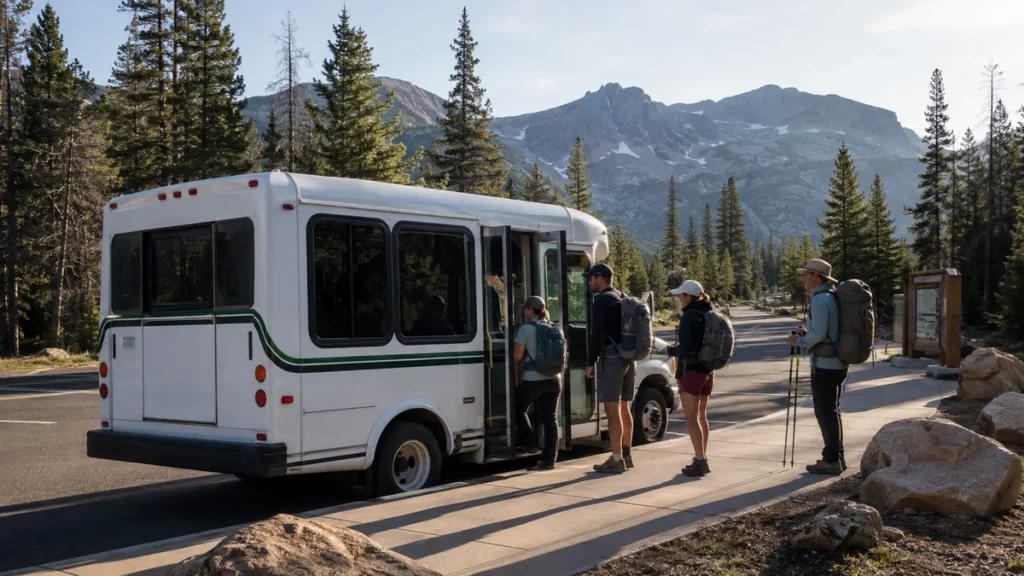
For 2026, the current NPS Bear Lake Shuttle schedule lists service from 6:30 a.m. to 7:30 p.m., normally every 10–15 minutes, with stops at Park & Ride, Glacier Gorge Trailhead, and Bear Lake. NPS updated the detailed shuttle schedule in August 2026, so I would still check it before relying on a specific bus.
The official RMNP shuttle schedule is the page I would use rather than an old screenshot or blog timetable.
One practical point is easy to miss: an extremely early pre-dawn start and the regular shuttle do not necessarily work together.
If I wanted to be hiking well before 6:30 a.m., I needed another trailhead-access plan.
Do You Need a Permit for the Sky Pond Hike in 2026?
Yes, during designated hours in the 2026 timed-entry season.
Sky Pond is reached through the Bear Lake Road Corridor. In 2026, Rocky Mountain National Park requires a Timed Entry + Bear Lake Road reservation from 5 a.m. to 6 p.m. daily from May 22 through October 18.
That reservation covers access to places including Glacier Gorge Trailhead and Bear Lake.
It is not the same thing as the normal park entrance fee or pass.
That distinction initially looked more complicated to me than it really was:
Timed Entry + Bear Lake Road controls access to the corridor during reservation hours.
The entrance pass or park fee covers admission to Rocky Mountain National Park.
The timed-entry reservation currently carries a $2 Recreation.gov processing fee.
Because these rules can change from one season to another, I checked the official 2026 Timed Entry + Bear Lake Road information rather than relying on an older hiking article.
Can You Hike Sky Pond Without a Timed-Entry Reservation?
Under the 2026 system, the reservation requirement for the Bear Lake Road Corridor begins at 5 a.m.
That means entering the corridor before 5 a.m. is different from arriving once the controlled window has started.
But I would not think of a pre-5 a.m. arrival as a consequence-free permit shortcut.
It can mean:
- waking up extremely early,
- driving Bear Lake Road in darkness,
- starting with a headlamp,
- colder temperatures,
- and arriving before regular shuttle service begins.
That may be practical from Estes Park.
From Denver, it turns the morning into a considerably bigger commitment.
My Sky Pond Hike, Section by Section
Glacier Gorge to Alberta Falls
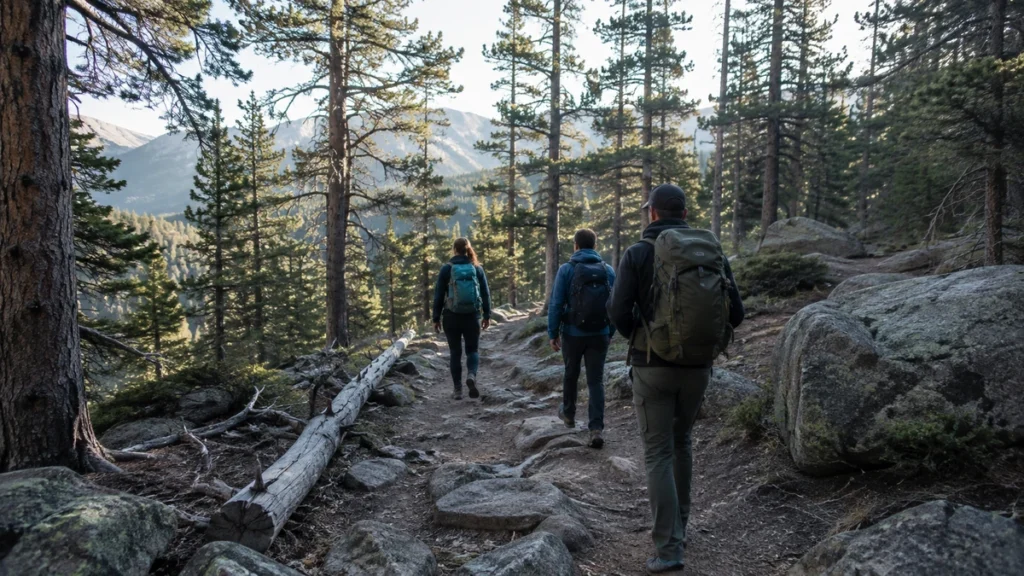
The beginning felt much easier than all my pre-hike research had prepared me for.
The trail moved through forest beside running water, and for a while the day felt like a normal Rocky Mountain National Park hike.
Then I reached Alberta Falls.
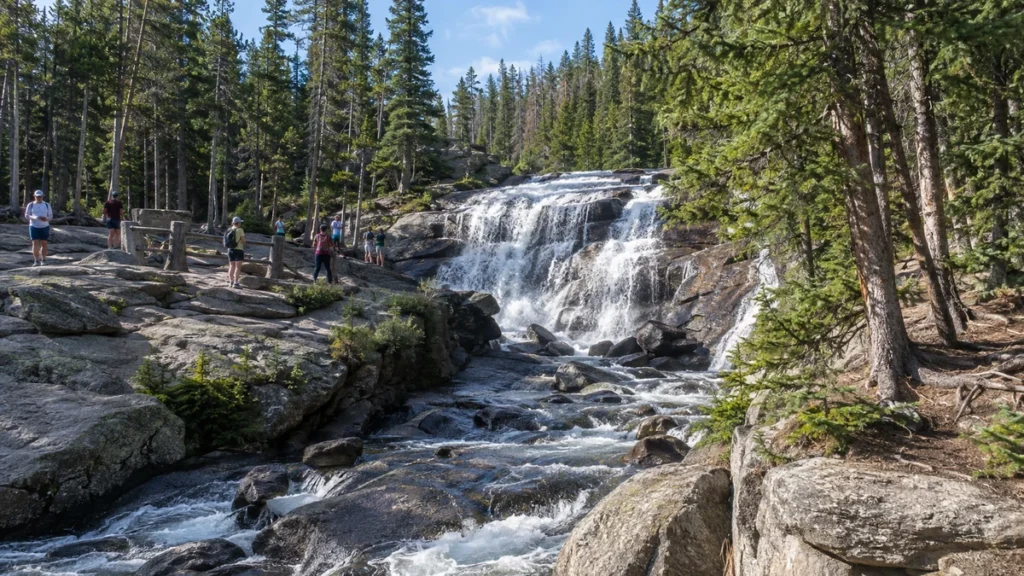
This was the first place where the crowd noticeably thickened.
Alberta Falls is accessible enough that plenty of visitors stop there without continuing toward The Loch or Sky Pond. Between the rushing water, people moving around viewpoints, and hikers coming from both directions, it felt busier than the trail that followed.
The falls were worth seeing, but I did not need a long stop.
Once I continued uphill, things gradually became quieter.
Alberta Falls to The Loch
This was where the hike began to feel more substantial.
The climbing became steadier, and the altitude started affecting my pace.
Nothing felt technically difficult, but I noticed that maintaining the speed I normally used on a moderate trail required more effort than expected.
Then The Loch, also called Loch Vale, appeared.
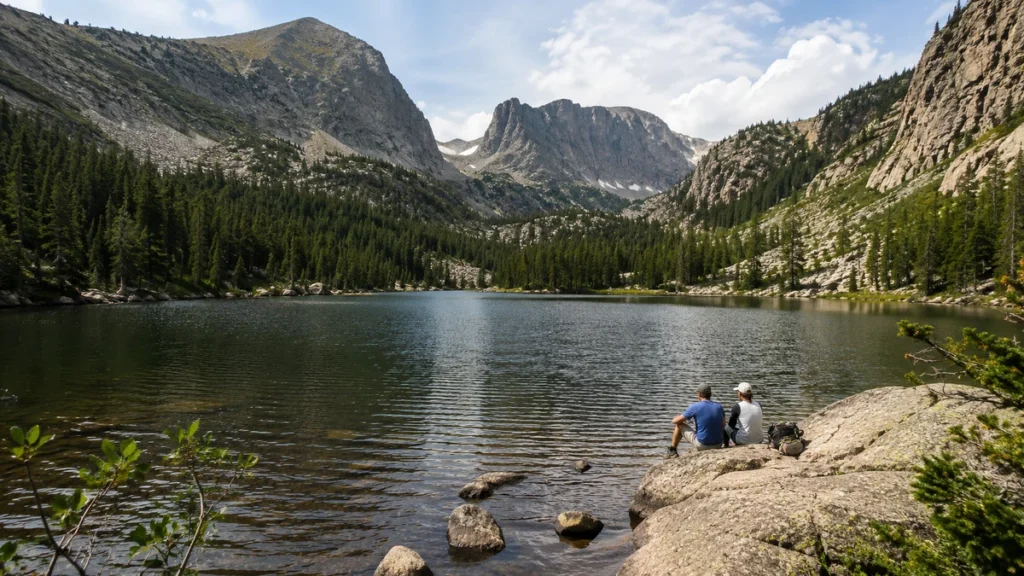
I spent longer there than I had planned.
The water and surrounding mountains made The Loch feel like a legitimate destination rather than somewhere I was merely passing through.
It also became my first meaningful decision point.
Had the clouds looked worse or my energy dropped sharply, I could have turned around there without feeling that I had wasted the day.
That was an important lesson from this hike:
Sky Pond does not have to be reached for the route to be worthwhile.
The Loch to Timberline Falls
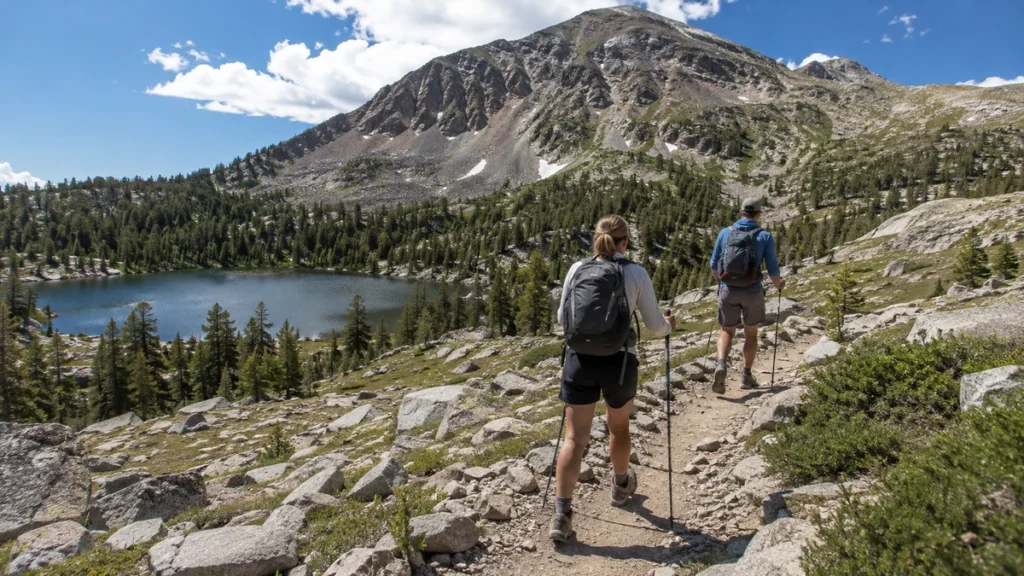
Beyond The Loch, the character of the trail changed again.
The surroundings felt more alpine. The terrain became rockier, and Timberline Falls eventually appeared ahead.
From farther away, it did not look especially intimidating.
Standing below it was different.
The route climbed beside the falling water, and several sections of rock were wet.
This was the part of the hike I had spent the most time thinking about before the trip.
Seeing it in person finally explained why.
What the Timberline Falls Scramble Was Actually Like
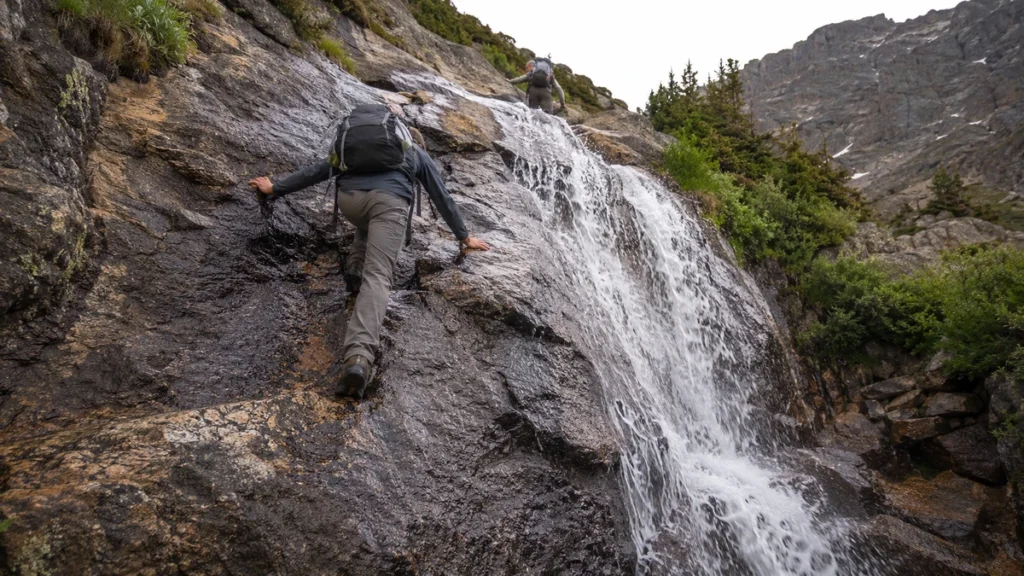
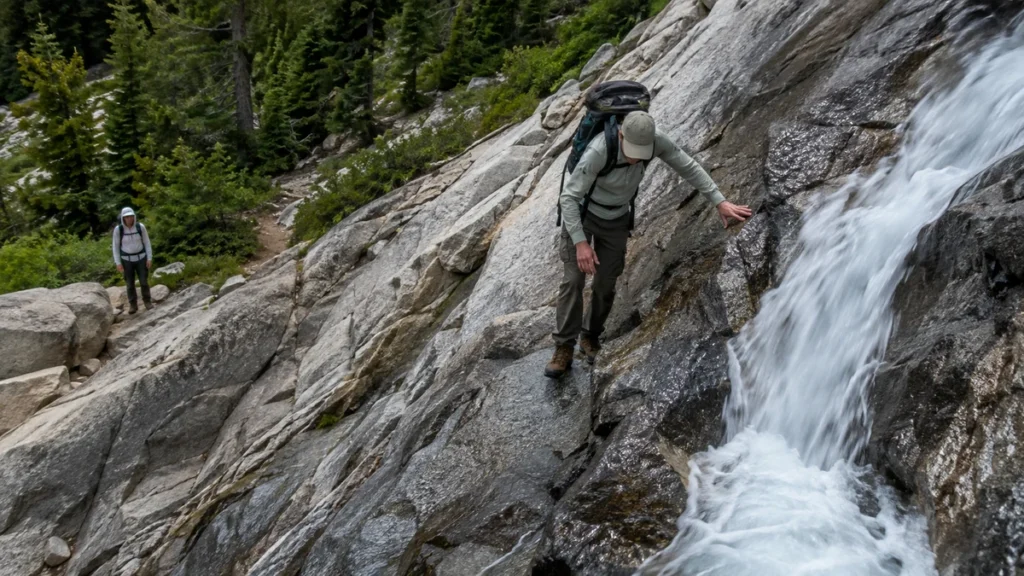
Timberline Falls was the most technical section of my Sky Pond hike, but “climbing a waterfall” makes it sound more extreme than what I encountered in good summer conditions.
It was a short, steep scramble where I needed my hands.
I slowed down, tested footholds, and waited when another hiker occupied the narrowest part.
The water mattered more than the height.
Dry rock that looked ordinary felt completely different from a smooth foothold covered in spray.
My trekking poles had helped on the regular trail, but this was where I wanted both hands free.
I packed them away before starting the scramble rather than trying to manage poles while climbing.
Is Timberline Falls Scary?
It looked more intimidating from below than it felt once I was moving.
The biggest improvement came when I stopped looking at the entire slope and concentrated on one secure foothold at a time.
Still, I would not dismiss the scramble as “easy.”
Comfort with this kind of terrain is personal.
A hiker with previous scrambling experience may find Timberline Falls fun. Someone with a strong fear of heights or no experience using hands on rock may feel completely different.
Trail conditions matter even more.
Wet summer rock is one problem.
Snow and ice are another.
That is why a comment from somebody who hiked Timberline Falls in July does not tell me what the same section will be like in June, October, or winter.
Going Down Timberline Falls Was Harder Than Going Up
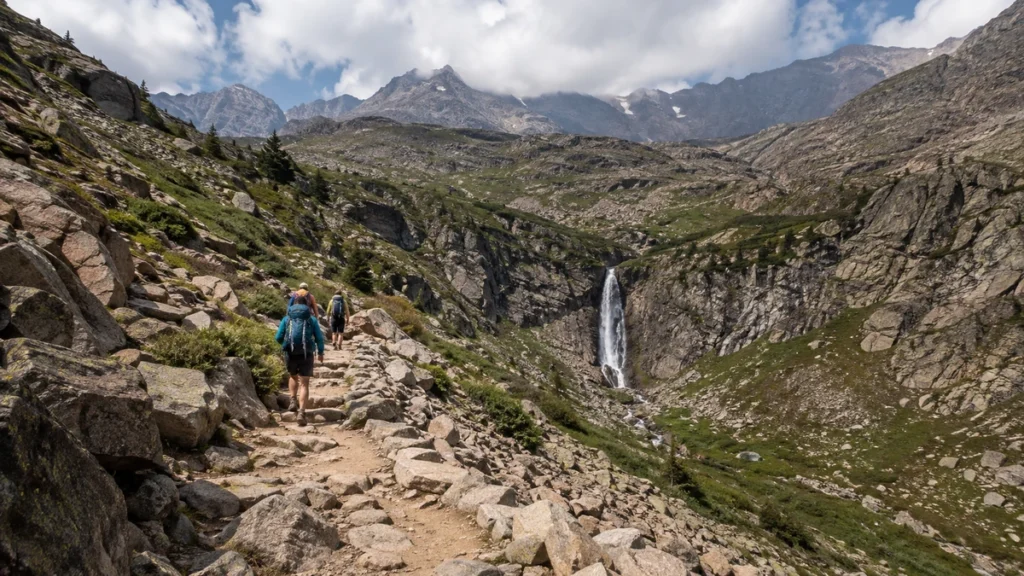
This was one of the biggest surprises of the hike.
Before arriving, I had spent nearly all my mental energy thinking about the climb.
The descent required more concentration.
Going up, the next handhold was usually easy to see. Coming down, some footholds sat beneath me and outside my immediate line of sight.
I had to slow down, turn toward the rock where necessary, and make sure my foot was secure before shifting my weight.
Crowds mattered too.
By the time I descended, more hikers were coming up. Timberline Falls is not a broad staircase where people can comfortably pass anywhere.
Waiting for someone else to clear a section cost almost no time.
Trying to rush past them would have gained nothing.
Lake of Glass Is Not Sky Pond
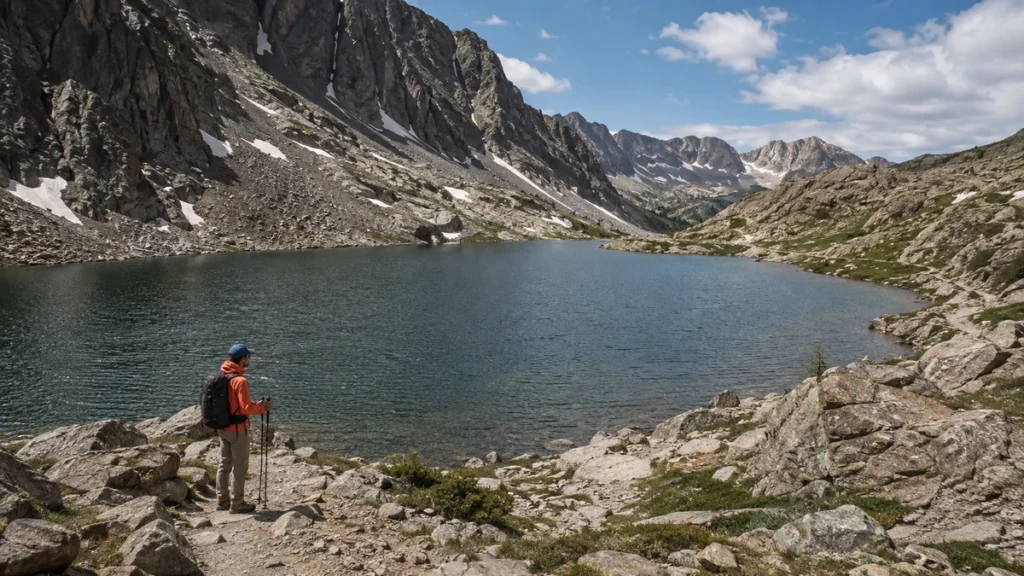
After Timberline Falls, I reached Lake of Glass.
For a moment, it felt like I had finished.
That surprised me because I knew from studying the route that another lake came before Sky Pond.
The combination of tired legs, the waterfall scramble, and a dramatic alpine lake was enough to make my brain briefly register Lake of Glass as the destination.
It is not.
Sky Pond is farther ahead.
The route beyond Lake of Glass felt less formal than the busy trail lower down, so I paid more attention to where I was walking rather than following every worn patch of ground.
The alpine vegetation was another reason to stay on the established route.
Saving a few seconds with a shortcut was not worth damaging such a fragile landscape.
Reaching Sky Pond
Sky Pond itself felt more dramatic in person because of what surrounded it.
The lake sat below steep granite walls, with the Sharkstooth and neighboring spires rising above the basin.
I had seen photographs beforehand, but they had not really conveyed how enclosed the lake felt beneath those peaks.
The wind was another surprise.
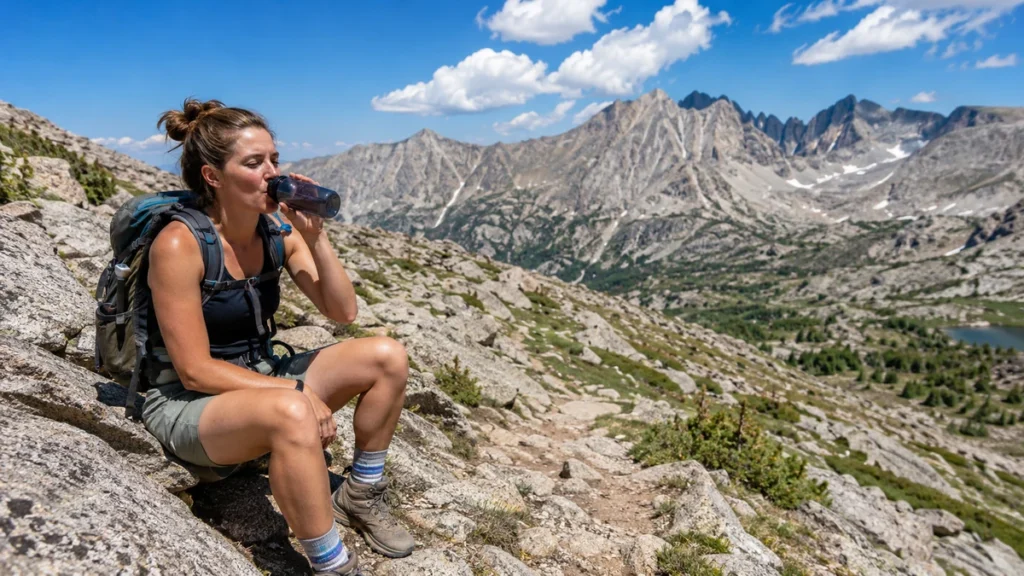
I had been warm while climbing. Once I stopped walking beside the lake, I cooled down quickly.
The extra layer sitting in my pack suddenly became much more valuable.
I ate, drank, took photos, and stayed long enough to enjoy the setting without turning the stop into an hour-long break.
One thought kept returning:
Sky Pond was only the halfway point.
Reaching the lake was exciting, but the hike ended back at Glacier Gorge.
That was why I had deliberately kept food, water, and energy in reserve.
Altitude Was a Bigger Factor Than the Mileage
Sky Pond sits at roughly 10,900 feet, while Glacier Gorge Trailhead is already above 9,000 feet.
That made the hike feel different from a similar distance and elevation gain closer to sea level.
I did not suddenly become ill. The change was subtler.
My breathing became heavier sooner. My normal hiking pace stopped feeling normal. Short breaks became more useful.
A fit visitor arriving from a low-elevation city can still feel altitude.
That is not a fitness failure.
I treated headaches, dizziness, nausea, unusual weakness, or worsening breathing as reasons to reconsider continuing rather than symptoms to defeat through determination.
A vacation itinerary was never important enough to make pushing higher worth it.
Spending some time around Estes Park before attempting the hike also made more sense to me than flying into Denver and immediately making Sky Pond the first major activity.
Weather Can Change the Entire Hike
The weather I saw at breakfast was not necessarily the weather I would get several hours later above The Loch.
Rocky Mountain National Park is high mountain terrain, and conditions can change quickly with elevation.
An early start gave me more flexibility, but I still watched the sky rather than assuming the morning forecast guaranteed anything.
I was especially cautious about continuing toward Timberline Falls if dark clouds were building.
The National Park Service’s current trail report, updated August 21, 2026, notes that conditions can change rapidly and that high-elevation trails may differ significantly from lower areas of the park. It also advises hikers to be prepared to turn around.
Before hiking, I checked the official Rocky Mountain National Park trail conditions.
That page was more useful than assuming the trail would be dry simply because Estes Park was warm.
Where I Would Turn Around
One of the strengths of the Sky Pond route is that turning around early does not automatically ruin the day.
Alberta Falls
If I had felt unwell or the weather looked poor almost immediately, Alberta Falls still made the outing worthwhile.
The Loch
This was my favorite fallback destination.
The scenery was already good enough that I could have ended the hike there without feeling cheated.
Below Timberline Falls
If the scramble had been icy, extremely wet, excessively crowded, or simply outside my comfort level, this was the obvious place to stop.
No lake was important enough to make ignoring my own judgment worthwhile.
Lake of Glass
Turning around here would be psychologically difficult because Sky Pond is relatively close.
That does not make continuing automatically sensible.
A storm does not care whether I am “almost there.”
Best Time to Hike Sky Pond
For most recreational hikers, summer into early fall generally offers the simplest conditions, but I would never plan Sky Pond from the calendar alone.
High-elevation snow, ice, rain, and temperature changes vary from year to year.
| PeriodWhat I Would Plan Around | |
|---|---|
| May | Winter-like upper trail conditions may remain |
| June | Snow and ice can still affect high terrain |
| July | More typical summer hiking, plus crowds and storms |
| August | Generally favorable access with continued storm risk |
| September | Cooler temperatures and often excellent hiking |
| October | Greater chance of ice, snow, and rapid changes |
| Winter | A much more serious snow-travel objective |
The official trail report matters more to me than a generic statement that “June is hiking season” or “October is still fine.”
As of the August 21, 2026 NPS update, most lower park trails were clear or mostly dry, but the agency still warned that conditions vary by elevation and can change quickly.
What I Actually Needed in My Pack
I did not need technical climbing equipment in normal summer conditions.
The ordinary items mattered most:
- hiking shoes or boots with dependable traction,
- enough water for a long day,
- food and salty snacks,
- waterproof shell,
- warm layer,
- sunscreen,
- sunglasses,
- trekking poles,
- headlamp,
- offline navigation,
- and a fully charged phone.
Traction was the part of my footwear I cared about most.
Timberline Falls was not where I wanted smooth soles.
Trekking poles helped during the normal climb and especially on tired legs during the descent. I simply stowed them before the hands-on section.
The warm layer was easy to underestimate at the trailhead. Moving uphill kept me comfortable, but sitting beside Sky Pond in the wind was different.
I also downloaded my route before starting rather than assuming I would always have reliable mobile service.
Who I Think Should Skip Sky Pond
Sky Pond gets enough attention online that it can start feeling compulsory.
It is not.
I would choose another hike if:
- I had never completed a long mountain hike,
- I was already feeling poorly at altitude,
- scrambling on wet rock caused serious anxiety,
- Timberline Falls was snowy or icy beyond my experience,
- thunderstorms were developing,
- my footwear lacked traction,
- or I had started so late that completing the hike required rushing.
Rocky Mountain National Park has too many worthwhile trails to force the wrong one.
Sky Pond vs Other RMNP Hikes
For a first-time visitor with limited hiking days, this comparison is more useful than declaring one trail “best.”
| Hike | Best For | Main Trade-Off |
|---|---|---|
| Sky Pond | Strong hikers wanting varied scenery and scrambling | Long day plus Timberline Falls |
| Emerald Lake | Easier first-time alpine-lake hike | Busier and much less challenging |
| Chasm Lake | Strong hikers wanting dramatic alpine terrain | Demanding high-elevation day |
| Mills Lake | Scenic Glacier Gorge hike without the waterfall scramble | Less adventurous |
| Black Lake | Longer wilderness-style hike without Timberline Falls | Still physically demanding |
If Timberline Falls were the only reason I felt uneasy about Sky Pond, I would seriously consider Mills Lake or Black Lake instead of forcing myself through a scramble I did not want to do.
The Mistakes I Made and What I Learned
My first mistake was spending too much time worrying about exact mileage.
I tried to reconcile every 8.5-, 9-, and nearly 10-mile figure I found.
Once I was actually hiking, the difference mattered far less than altitude, weather, breaks, and how much energy I kept for the return.
Parking was another thing I initially treated too casually.
The Park & Ride option sounded less convenient on paper. In practice, removing the stress of hunting for a small trailhead space made the start of the day easier.
I also spent far more time worrying about climbing Timberline Falls than descending it.
The climb looked more dramatic.
The descent required more patience.
Finally, I mentally treated Sky Pond as the finish line.
It was not.
The hike finished when I returned to the trailhead.
That simple shift helped me pace the entire day better.
Sky Pond Hike FAQ
How long is the Sky Pond hike?
I planned for roughly 8.5–10 miles round trip, depending on the starting point, exact route, and how distance is measured.
NPS currently lists Sky Pond at 4.2 miles one way from Glacier Gorge in its Bear Lake Road Corridor guide.
How long does the Sky Pond hike take?
I would keep roughly six to eight hours available.
Stronger and well-acclimatized hikers can finish faster, while breaks, photography, crowds around Timberline Falls, altitude, and weather can extend the day.
I would not book an important afternoon activity based on the fastest hiking time I found online.
Is the Sky Pond hike scary?
Most of the route felt like normal mountain hiking to me.
Timberline Falls was the exception.
That section involved a short scramble on steep rock that can be wet. It felt manageable in suitable conditions, but someone with a strong fear of heights or scrambling may experience it very differently.
Do you need climbing skills for Timberline Falls?
I did not need ropes or technical climbing skills in normal summer conditions.
I did need my hands, good footing, decent traction, and patience.
Snow or ice can make the same terrain much more serious.
Can beginners hike Sky Pond?
Some fit beginners with previous hiking experience can complete Sky Pond in good conditions.
I would not make it someone’s first demanding mountain hike because distance, altitude, weather, and Timberline Falls all add difficulty.
Can kids hike Sky Pond?
Age alone does not answer this well.
A child accustomed to long mountain hikes and scrambling may be more comfortable here than an inexperienced adult.
Endurance, weather, altitude, and confidence on Timberline Falls matter more than a simple age cutoff.
Are dogs allowed on the Sky Pond Trail?
No.
Pets are prohibited on trails, tundra, and meadows in Rocky Mountain National Park.
Is Lake of Glass the same as Sky Pond?
No.
Lake of Glass comes first, immediately above Timberline Falls.
Sky Pond is farther up the route.
What time should I start the Sky Pond hike?
Earlier worked better for me because it gave me more time, cooler hiking conditions, and extra weather margin.
Anyone planning to start before the regular Bear Lake Shuttle operates needs to arrange trailhead access accordingly.
Is Sky Pond worth the hike?
It was for me.
The final lake was only part of the reason.
Alberta Falls, The Loch, Timberline Falls, Lake of Glass, and Sky Pond made the route feel varied enough that the day kept rewarding the effort.
Final Thoughts
The moment I remembered most from the Sky Pond hike was not actually standing beside Sky Pond.
It was reaching the bottom of Timberline Falls and realizing that the short scramble I had spent so much time worrying about looked steeper in person than it had on my screen.
A few minutes later, once I slowed down and concentrated on one foothold at a time, it felt manageable.
That summed up much of the hike.
The mileage became less intimidating once I broke the route into landmarks. The altitude became easier to manage once I stopped worrying about pace. Parking became less stressful once I accepted the shuttle as part of the plan. Even reaching Sky Pond became more enjoyable once I stopped treating it as something I had to accomplish regardless of conditions.
By the time I returned to Glacier Gorge, my legs were tired enough that I had no interest in describing the hike as easy.
But I understood why people remember it.
For me, Sky Pond earned its reputation because the route kept giving something back for the effort—from Alberta Falls and Loch Vale to Timberline Falls, Lake of Glass, and the final alpine basin beneath the Sharkstooth.