



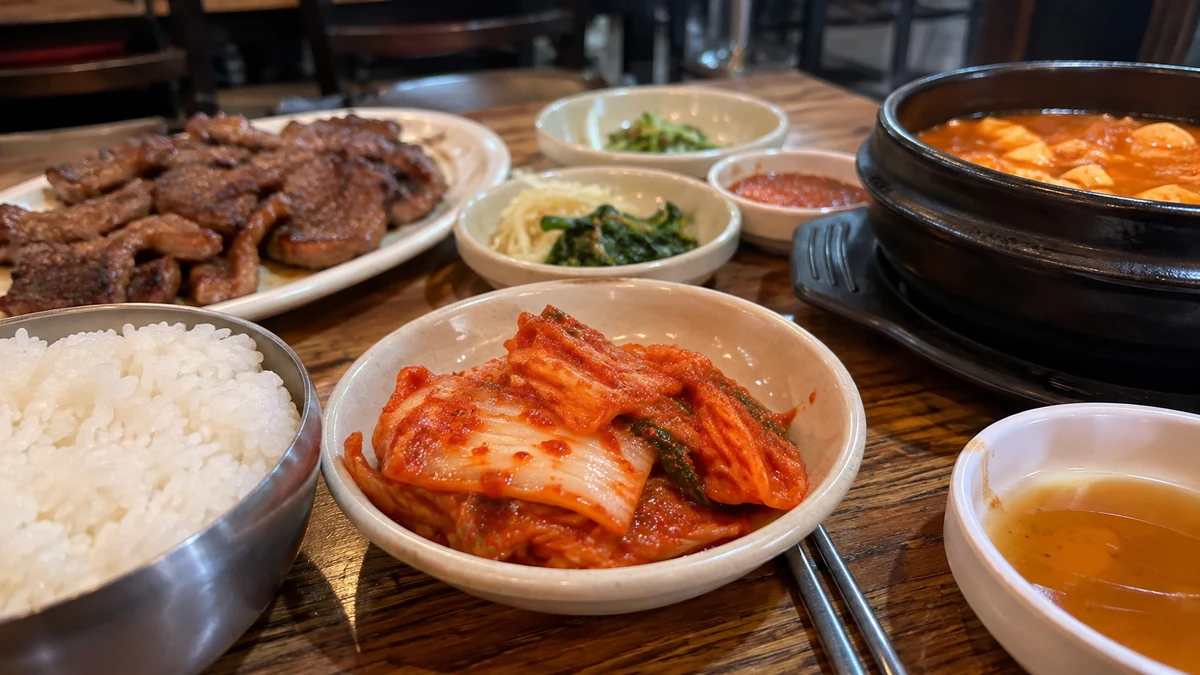
If you are searching for the Korean national food, the simplest answer is kimchi. This fermented vegetable dish is one of the strongest symbols of Korean cuisine and a familiar part of everyday meals across South Korea.
I knew that answer before visiting Korea, but I did not really understand it. I had eaten packaged kimchi at home and thought of it mainly as spicy fermented cabbage served beside Korean barbecue. Once I started eating around Seoul, that description felt far too narrow.
Kimchi appeared beside grilled pork, rice, dumplings, soups, noodles, and bubbling stews. More surprisingly, it rarely tasted exactly the same twice. One restaurant served it crisp, garlicky, and fairly fresh. Another brought out a softer batch with a much sharper fermented sourness.
Bibimbap was more colorful. Korean barbecue was more entertaining. Fried chicken was easier to crave immediately. Yet kimchi was the food that kept connecting one meal to the next.
That is why I came to understand kimchi as Korea’s national food: not because it is always the main attraction, but because it is deeply woven into the way Korean food is prepared, shared, and eaten.
What Is the National Food of Korea?
Kimchi is widely regarded as Korea’s national or representative food, particularly in South Korea.
The version most visitors recognize is made from napa cabbage fermented with seasonings such as salt, garlic, ginger, Korean red pepper flakes, and sometimes fermented seafood. But cabbage is only one starting point. Radish, cucumber, mustard greens, green onions, and other vegetables are also used.
One detail is worth clarifying because search results can make the subject unnecessarily confusing.
You will often see kimchi described as the “national dish of South Korea.” I use that phrase in a cultural sense rather than treating it as a formal title. Official Korean tourism material emphasizes kimchi as a fundamental part of the Korean table, while its cultural significance goes far beyond a single recipe.
That also explains why bibimbap and bulgogi sometimes appear in discussions about Korea’s national dish. Both are important Korean foods, but they represent the cuisine differently.
Why Kimchi Represents Korean Food So Well
Before the trip, I assumed a national dish should be something substantial enough to order as a meal on its own.
Kimchi changed that idea almost immediately.
At one of my first proper Korean meals, several small plates appeared before I had worked out exactly what I had ordered. There was rice, soup, vegetables, sauces, kimchi, and other banchan, the side dishes that accompany many Korean meals.
For a few seconds, I wondered whether I had accidentally ordered extras.
I hadn’t.
The meal was simply structured differently from the starter-main-side format I was used to.
The Korea Tourism Organization’s guide to Korean food culture describes rice and soup as central parts of the table, accompanied by main dishes and banchan, with kimchi regularly included.
That pattern became familiar surprisingly quickly.
Kimchi was not trying to compete with the meat, stew, or noodles. It balanced them.
A rich piece of samgyeopsal tasted better after something acidic and fermented. Plain rice became more interesting with a bite of kimchi. A hot stew felt less heavy when I alternated it with something cool and crunchy.
It was that everyday usefulness, rather than one spectacular serving, that made kimchi feel genuinely important.
If Kimchi Is a Side Dish, Why Is It Korea’s National Food?
This was one of the things I misunderstood before visiting.
Kimchi is commonly served as banchan, so at first it seemed strange that a side dish could represent an entire cuisine.
The answer made more sense once I stopped looking at Korean meals through a Western idea of what counts as the “main” food.
A Korean table can include rice, soup or stew, meat or fish, vegetables, fermented sauces, kimchi, and several additional side dishes at the same time. Diners combine them differently rather than treating everything else as secondary to one large centerpiece.
Kimchi’s importance is therefore not about portion size.
Its significance comes from its everyday presence, history, fermentation tradition, regional variation, and place within Korean food culture.
Being a side dish may actually help explain its importance. Kimchi can accompany dozens of different meals without replacing any of them.
What Is Kimchi Made From?
The kimchi most international visitors recognize is baechu-kimchi, made primarily with napa cabbage.
Common ingredients include:
- Napa cabbage
- Korean radish
- Salt
- Gochugaru, or Korean red pepper flakes
- Garlic
- Ginger
- Green onion
- Fish sauce
- Jeotgal, or fermented seafood
There is no single recipe.
The vegetables, seasoning, fermentation time, season, region, and household preferences can all change the finished kimchi.
That variation was something I had underestimated.
I expected restaurants to serve slightly better or worse versions of roughly the same food. Instead, one place brought cabbage kimchi that tasted fresh, crisp, and heavily garlicky. At another meal, the kimchi was softer, stronger, and much more sour.
The second version was almost too intense when I ate it alone.
Beside grilled pork, it suddenly made sense.
That became one of my most useful food lessons from the trip: kimchi is often better judged as part of a meal rather than in isolation.
What Does Kimchi Taste Like?
There is no single kimchi flavor.
Depending on its ingredients and stage of fermentation, it can taste:
- Sour
- Salty
- Spicy
- Garlicky
- Savory
- Slightly sweet
- Funky
- Fresh
- Deeply fermented
Texture varies too.
Fresh or lightly fermented cabbage can stay wonderfully crunchy. As kimchi ages, it normally becomes softer and develops stronger acidity.
Before Korea, I mostly associated kimchi with heat.
Once there, sourness, garlic, salt, and fermentation mattered just as much as chili.
That was probably the biggest difference between the kimchi I had eaten outside Korea and the versions I remembered most after the trip.
Older kimchi also made more sense once I tried it cooked. Its stronger flavor works particularly well in dishes such as kimchi jjigae, a hot kimchi stew, and kimchi bokkeumbap, or kimchi fried rice.
Is All Korean Kimchi Spicy?
No.
This is useful to know if the bright red color has put you off trying it.
The familiar cabbage version often contains plenty of gochugaru, but not every kimchi relies heavily on chili.
Baek-kimchi, or white kimchi, is much milder.
Dongchimi is a watery radish kimchi with a refreshing sourness rather than the strong red-chili flavor many first-time visitors expect.
I was surprised by how different these tasted from standard baechu-kimchi.
If the first spicy cabbage kimchi you try is too aggressive, try another style before deciding you dislike kimchi altogether.
Types of Kimchi Worth Trying in Korea
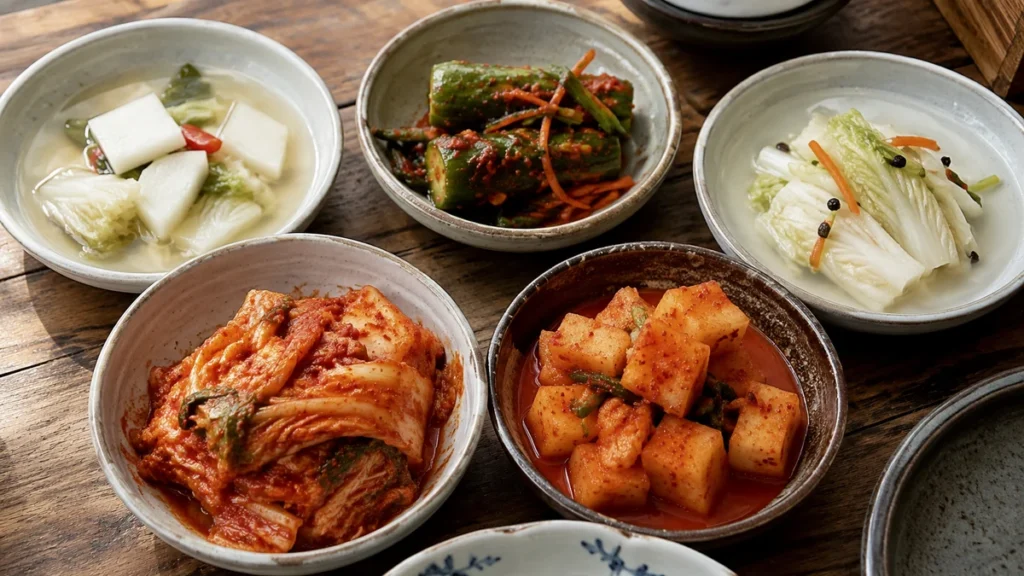
Once I realized how broad the category was, I started paying more attention to the small kimchi dishes arriving with meals.
| Type | Main ingredient | Typical character | Good choice for |
|---|---|---|---|
| Baechu-kimchi | Napa cabbage | Savory, spicy, increasingly sour with fermentation | First-time visitors |
| Kkakdugi | Cubed radish | Crunchy, juicy, usually spicy | Anyone who likes firm textures |
| Oi-sobagi | Cucumber | Fresh, crisp, aromatic | Lighter meals |
| Baek-kimchi | Napa cabbage | Mild and clean | Travelers avoiding chili |
| Dongchimi | Radish | Cool, watery, gently sour | Rich or heavy meals |
| Gat-kimchi | Mustard greens | Strong and peppery | More adventurous eaters |
| Pa-kimchi | Green onions | Savory and aromatic | Fans of stronger flavors |
Kkakdugi ended up being one of my favorites.
The cubes of radish stayed satisfyingly crisp and worked especially well beside soup. They were also much easier to pick up neatly than long, slippery pieces of cabbage—a small detail, but one I appreciated after dropping cabbage back into my bowl more than once.
Kimjang Explains Why Kimchi Is More Than Food
The strongest reason kimchi carries so much cultural weight may have less to do with eating it than with making it.
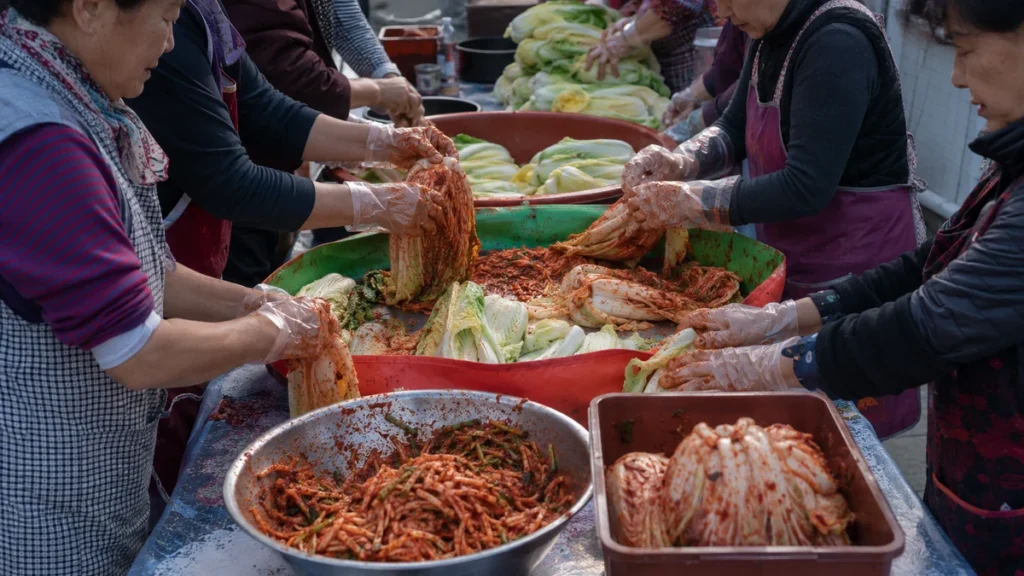
Kimjang is the tradition of preparing and sharing large quantities of kimchi, historically linked with preparing food for winter.
Learning about kimjang changed how I thought about kimchi. Recipes and techniques can pass through families. People work together. Ingredients and methods change between households and regions.
In 2013, UNESCO inscribed “Kimjang, making and sharing kimchi in the Republic of Korea” on its Representative List of the Intangible Cultural Heritage of Humanity. UNESCO highlights both the importance of kimchi in Korean meals and the way kimjang helps strengthen family and community ties.
The UNESCO page on Korea’s kimjang tradition is worth reading if you want to understand why kimchi matters beyond the restaurant table.
That context also changed how I looked at Korean food markets.
Large piles of napa cabbage and radish stopped looking like ordinary produce displays. Gochugaru, garlic, fermented seafood, and other seasonings were part of a much larger food tradition than the little bowl of kimchi I was used to seeing abroad.
Kimchi vs. Bibimbap vs. Bulgogi: Which Best Represents Korea?
This is where online answers often become muddled.
Kimchi, bibimbap, and bulgogi can all represent Korean cuisine, but they do so in different ways.
| Food | What it is | Why it represents Korea | My take |
|---|---|---|---|
| Kimchi | Fermented vegetables | Everyday meals, fermentation, kimjang, cultural identity | Strongest answer for Korea’s national food |
| Bibimbap | Rice mixed with vegetables and other toppings | Brings several Korean ingredients into one bowl | Best single-dish introduction |
| Bulgogi | Marinated beef or other meat | Familiar sweet-savory flavors and broad appeal | Easy starting point for newcomers |
| Korean barbecue | Meat grilled at the table with banchan and wraps | Shows the communal side of Korean dining | Best dining experience rather than one dish |
| Korean fried chicken | Crisp fried chicken, often sauced | A major part of modern Korean food culture | Popular, but less connected with older traditions |
For me, bibimbap came closest to feeling like a complete national “dish.”
It combines rice, vegetables, sauce, and often egg or meat in one bowl. It is easy to understand, filling without being too heavy, and gives newcomers several Korean flavors in one meal.
Kimchi still felt more culturally important.
That distinction matters.
The easiest Korean dish to introduce to a visitor is not necessarily the food that best represents Korean food culture.
What a Korean Meal Actually Looks Like
One weakness I noticed in many Korean food guides before traveling was that they treated dishes as isolated items.
Real meals made much more sense once I understood a few basic terms.
Bap is rice.
Guk is soup.
Jjigae is stew.
Banchan are side dishes.
Jang refers to fermented sauces and pastes, including doenjang and gochujang.
Ssam involves wrapping food, commonly meat and other ingredients, in lettuce or perilla leaves.
Several of these can appear together on the same table.
At a Korean barbecue restaurant, for example, the pork was only one part of dinner. I could put a piece into a lettuce leaf with garlic, ssamjang, kimchi, and a little rice.
My first few wraps were ridiculously overloaded.
Once I stopped trying to fit every condiment into every bite, they became much better.
That style of eating also slowed dinner down. There was always something else to grill, share, wrap, or combine.
The experience taught me more about Korean food culture than simply ticking another famous dish off a list.
Other Korean Foods Worth Trying
Kimchi may answer the Korean national food question, but Korean cuisine is far too varied to build an entire trip around fermented vegetables.
These were some of the foods that helped complete the picture for me.
Bibimbap
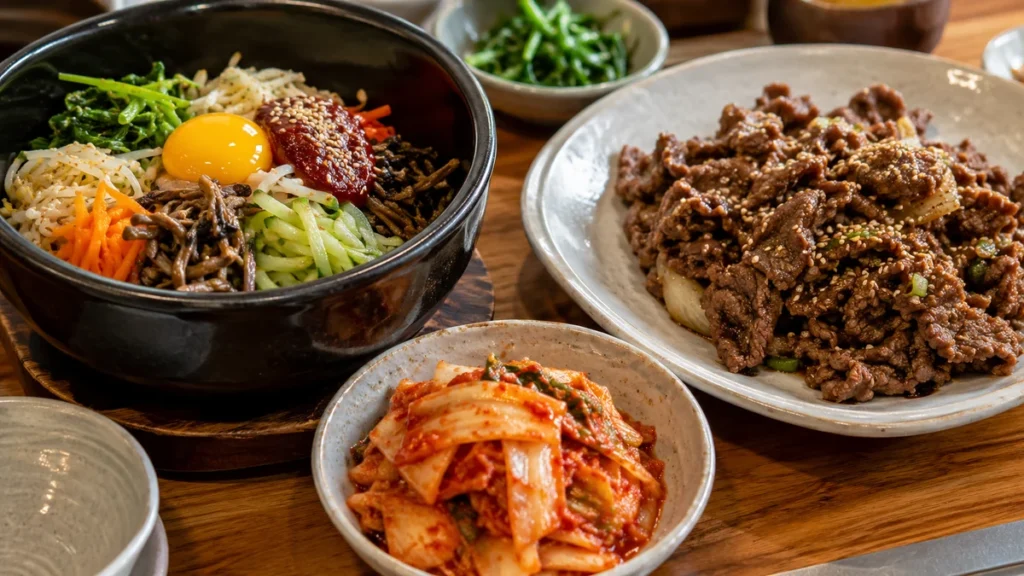
Bibimbap became one of my easiest meals when I wanted something filling without ordering a large shared spread.
It combines rice with vegetables and other toppings, often including egg, meat, and gochujang.
The bowl looked much prettier before I mixed it, but it tasted better afterward.
Different textures in the same spoonful were what made the dish interesting rather than any one ingredient.
Jeonju is particularly associated with bibimbap, although the dish is easy to find elsewhere in South Korea.
Bulgogi
Bulgogi usually consists of thinly sliced marinated meat, most famously beef, with a sweet-savory flavor.
It was one of the least challenging foods I ate in Korea.
That is not a criticism.
For someone nervous about strong fermentation, seafood, or heavy chili, bulgogi is an easy place to start.
Samgyeopsal and Korean Barbecue
Korean barbecue was one of the meals where spending a little extra felt worthwhile because the experience was part of what I was paying for.
Samgyeopsal, or pork belly, became one of my favorites.
The meat itself can be simple. What makes the meal work is everything around it: grilled garlic, kimchi, ssamjang, lettuce or perilla leaves, rice, and banchan.
Barbecue also made more sense as a shared meal. Going with another person meant we could try more combinations without ordering an excessive amount of food.
Kimchi Jjigae
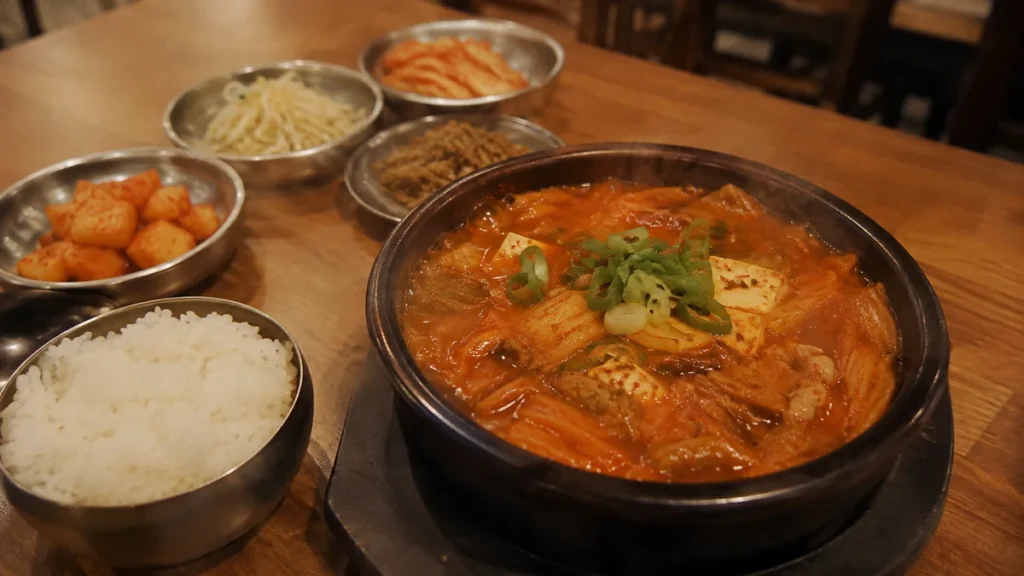
Kimchi jjigae changed my opinion of strongly fermented kimchi.
Sourness that could feel overwhelming when the kimchi was eaten cold became deeper and more balanced once cooked in a hot stew.
Versions can include tofu, pork, and other ingredients.
With rice on the side, it became one of the most satisfying straightforward meals I ate.
Tteokbokki
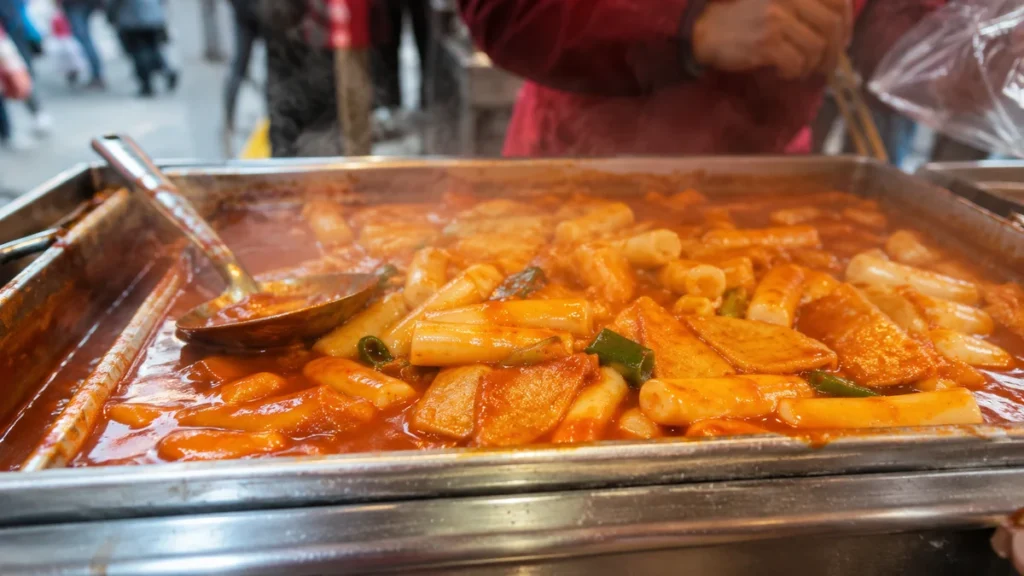
Tteokbokki was one of the street foods I had seen so often online that I assumed I knew what to expect.
I didn’t.
The chewy rice cakes were noticeably sweeter than I expected, even in a red sauce that looked aggressively spicy.
Texture mattered as much as heat. Anyone who dislikes chewy food may not understand the appeal, but I enjoyed it much more after the first few bites.
Mandu
Mandu are Korean dumplings and one of the easier choices when you want something familiar.
Fillings vary, and kimchi mandu gives hesitant diners another way to try kimchi without eating a strong fermented piece straight from the banchan plate.
Japchae
Japchae combines glass noodles with vegetables and seasoning, often with a lightly sweet and savory flavor.
I appreciated it most after several meals dominated by chili and fermentation.
Not every Korean dish is fiery, and japchae was a useful reminder of that.
Korean Fried Chicken
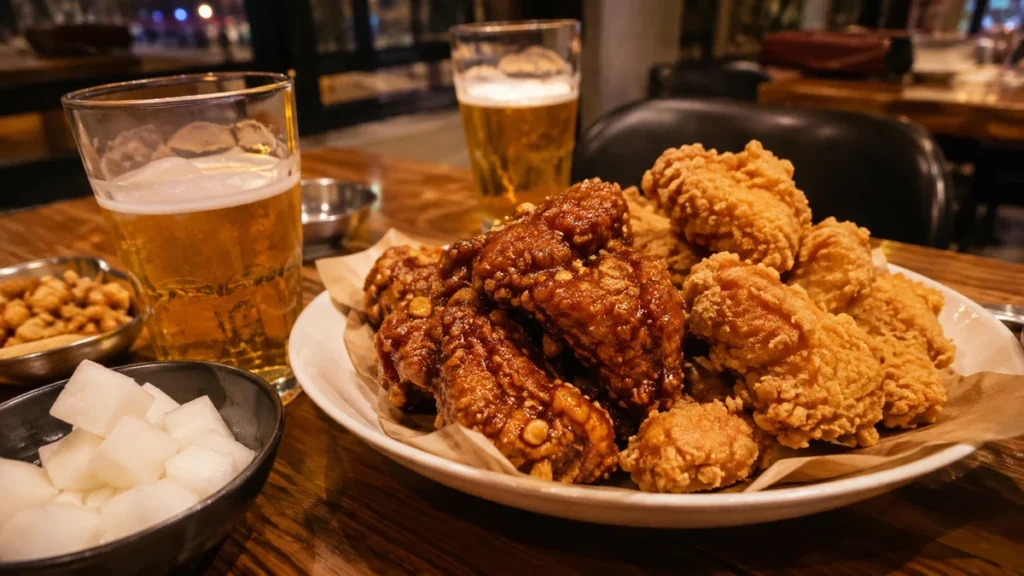
Korean fried chicken was one food I had almost dismissed before visiting because I assumed I could eat something similar at home.
That was a mistake.
A properly crisp batch alongside a cold beer was one of the simplest meals I enjoyed in Seoul.
The popular chicken-and-beer combination is known as chimaek.
It does not carry kimchi’s traditional significance, but modern Korean food culture would feel incomplete without it.
Naengmyeon and Kalguksu
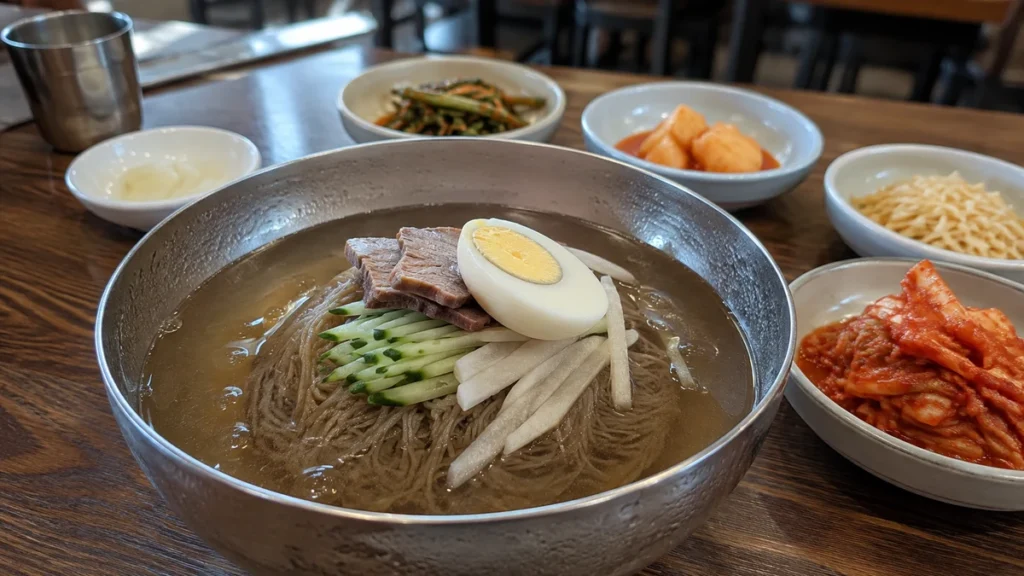
I focused so heavily on barbecue and street food while planning that noodles barely made my list.
That was poor planning.
Naengmyeon, served cold, was especially refreshing when the weather felt warm and humid.
Kalguksu, made with knife-cut noodles and commonly served in broth, went in the opposite direction: warm, simple, and comforting.
Hotteok

Hotteok became one of the few street snacks I deliberately bought more than once.
The pancake-like dough can be filled with a hot mixture containing brown sugar and cinnamon.
My first mistake was biting into the middle too quickly.
The filling stays much hotter than the outside suggests. Waiting another minute would have saved the roof of my mouth.
What Surprised Me Most About Eating in Seoul
My pre-trip “foods to try” list turned out to be less useful than I expected.
I had researched famous dishes.
I had not spent enough time learning how Korean meals actually worked.
A simple neighborhood restaurant serving rice, soup, kimchi, and several banchan sometimes taught me more about everyday Korean food than places I had selected because one dish looked famous online.
Gwangjang Market was enjoyable for the atmosphere. Food cooked on hot griddles, stools filled quickly, and there was always something else to look at a few steps away.
It was also crowded.
Standing in the middle of a narrow aisle trying to decide what to eat while people squeezed around me was not my finest piece of planning. I enjoyed the market more once I stopped trying to inspect every stall and simply picked something that looked good.
The busiest parts of Myeongdong felt different again.
Street food was convenient and fun to browse, but some snacks clearly appealed heavily to tourists. I tried a few, enjoyed some, and skipped others when I realized I was considering them because they photographed well rather than because I actually wanted to eat them.
Some of my more memorable everyday meals came from quieter restaurants away from the busiest tourist streets.
Mistakes I Made With Korean Food
Ordering too much
Banchan can make a meal larger than it looks on the menu.
I learned to order conservatively rather than assuming the main dish represented everything that would arrive.
Assuming red meant painfully spicy
Some dishes certainly had heat, but sweetness, garlic, fermentation, and savory flavors could be equally noticeable.
Color was not always a reliable guide.
Treating every famous food as essential
Eating became less enjoyable when I treated it like a checklist.
Once I stopped chasing every viral snack and concentrated on meals I actually wanted, both the food and the trip improved.
Ignoring ordinary-looking restaurants
Some of my better everyday food experiences came from places that looked completely unremarkable from the street.
A simple menu and a busy dining room often interested me more than elaborate décor.
Assuming vegetable dishes were vegetarian
Visible vegetables do not guarantee that a dish is vegetarian.
Stocks, sauces, stews, and kimchi can contain seafood or other animal ingredients.
Anyone following a strict diet needs to check rather than rely on appearance.
Is Kimchi Vegetarian or Vegan?
Not always.
This is one of the most important practical details for vegetarian and vegan travelers.
Traditional kimchi can contain fish sauce, salted shrimp, anchovy products, or other fermented seafood.
Vegan kimchi certainly exists, but appearance alone does not tell you what is in it.
The same caution applies to soups, noodle broths, and stews. A dish that looks vegetable-based may still have been prepared with anchovy, seafood, or meat stock.
If avoiding animal products matters, ask specifically.
Is Kimchi Healthy?
Kimchi is a fermented vegetable food, but I would be cautious about the exaggerated “superfood” claims surrounding it.
Recipes vary significantly. Salt levels, vegetables, seasonings, serving sizes, and fermentation methods are not identical from one batch to another.
For travelers, there is no need to turn kimchi into medicine to appreciate it.
I found it more useful to think about what it contributed to the meal: acidity, crunch, vegetables, fermentation, and enough flavor to balance richer foods.
Does Kimchi Belong Only to South Korea?
No.
Kimchi belongs to a broader Korean culinary tradition, even though this article focuses mainly on eating and traveling in South Korea.
Recipes, ingredients, preparation methods, and regional styles vary across the Korean Peninsula.
That wider context is useful because articles sometimes use “Korea” and “South Korea” as though they mean exactly the same thing. For a travel article about the Republic of Korea, “South Korean food” is the more precise description. When discussing the longer culinary tradition of kimchi, “Korean” is appropriate.
Korean National Food FAQ
What is the national food of Korea?
Kimchi is widely regarded as Korea’s national or representative food. It consists of fermented vegetables and exists in many regional and seasonal variations.
What is South Korea’s national dish?
Kimchi is the strongest answer in cultural terms. Bibimbap and bulgogi are also major representative Korean dishes, but kimchi has a particularly close connection with everyday meals and Korean food traditions.
Is bibimbap the national dish of Korea?
Bibimbap is one of Korea’s best-known dishes and an excellent introduction to Korean flavors, but kimchi has a stronger association with everyday food culture and fermentation traditions.
Is bulgogi Korea’s national food?
Bulgogi is one of the country’s most recognizable traditional meat dishes and is particularly approachable for first-time visitors. It does not have the same everyday cultural presence as kimchi.
Why is kimchi important in Korean culture?
Kimchi is a regular part of Korean meals, while the tradition of kimjang connects kimchi-making with families, communities, seasonal preparation, and shared cultural knowledge.
Is kimchi a main dish?
Usually not. Kimchi is commonly served as banchan, or a side dish. It is also cooked into dishes such as kimchi jjigae and kimchi fried rice.
Do Koreans eat kimchi every day?
Kimchi is a very common part of Korean meals, although individual habits naturally vary between people and households.
Is every kimchi spicy?
No. Baek-kimchi and dongchimi are two examples of styles without the heavy red-chili character many visitors associate with kimchi.
Is all kimchi made from cabbage?
No. Radish, cucumber, mustard greens, green onions, and other vegetables can all be used to make kimchi.
Is kimchi vegan?
Some versions are, but traditional recipes can contain fish sauce, salted shrimp, or other fermented seafood. Vegan travelers should check rather than assume.
What Korean foods should I try on a first trip?
Rather than trying to eat everything, I found that a mix of kimchi, bibimbap, Korean barbecue, kimchi jjigae, mandu, tteokbokki, japchae, noodles, and Korean fried chicken gave me a much better sense of how varied Korean cuisine actually is.
Final Thoughts
Before visiting South Korea, I already knew the textbook answer: kimchi is the Korean national food.
What changed during the trip was understanding why.
Kimchi was rarely the most expensive item on the table. It was not usually the largest, and it was not always the food I was most excited about when I sat down.
It simply kept appearing.
The flavor changed from restaurant to restaurant. It could be crisp or soft, mild or hot, fresh or sharply fermented. Sometimes it worked well on its own; often it made far more sense beside rice, grilled pork, or a steaming stew.
Bibimbap was easier to understand at first glance. Korean barbecue gave me some of the most enjoyable dinners. Fried chicken was probably the food I wanted to eat again fastest.
But kimchi connected those very different meals in a way nothing else did.
By the end of the trip, calling it Korea’s national food no longer felt like a fact I had memorized before leaving home.
It felt like the most natural answer.