



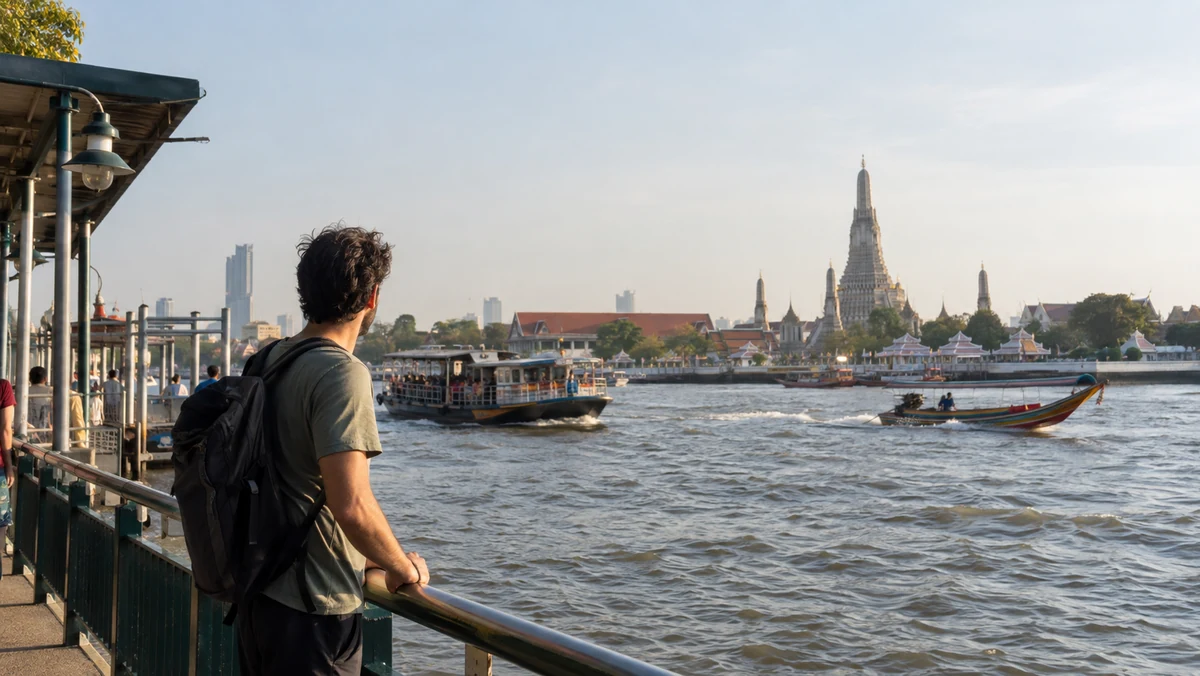
Two weeks in Thailand gave me enough time to combine Bangkok, Chiang Mai, and southern Thailand without turning the trip into a constant cycle of airports, ferries, and hotel check-ins.
The route that worked best was 3 nights in Bangkok, 4 nights in Chiang Mai, 5 nights around Ao Nang and Krabi, then one final night in Bangkok before flying home. It covered temples, street food, northern culture, mountains, beaches, and island scenery while keeping the number of major transfers under control.
The biggest lesson from planning my Thailand itinerary for 14 days was that 14 calendar days did not mean 14 full sightseeing days. Arrival, departure, hotel changes, and domestic flights quietly consumed several half-days.
You can add this naturally near the beginning:
I visited Thailand in March 2026, spending two weeks traveling through Bangkok, Chiang Mai, and Krabi. The trip gave me a firsthand look at how the heat, crowds, transport, and northern haze affected the itinerary.
I originally tried to squeeze in Phuket, Phi Phi, Chiang Rai, Pai, and Khao Sok as well. Once I looked at the real door-to-door travel time, most of them came back out.
My 14-Day Thailand Itinerary at a Glance
| Day | Overnight | Main Plan | Realistic Travel Time | Pace |
|---|---|---|---|---|
| 1 | Bangkok | Arrive, check in, easy dinner and neighborhood walk | Airport transfer: 45–90 min | Easy |
| 2 | Bangkok | Grand Palace, Wat Pho, Wat Arun, Chao Phraya River | Mostly local transport | Full |
| 3 | Bangkok | Market or neighborhood exploring, Chinatown at night | 1–2 hours total transit | Moderate |
| 4 | Chiang Mai | Fly Bangkok to Chiang Mai, Old City evening | About 4–5 hours door to door | Moderate |
| 5 | Chiang Mai | Wat Pha Lat, Doi Suthep, Nimman | About 1.5–2 hours local travel | Moderate |
| 6 | Chiang Mai | Cooking class, Old City temples, evening market | Minimal | Easy |
| 7 | Chiang Mai | Elephant sanctuary or Doi Inthanon | 2–4 hours total road time | Full |
| 8 | Ao Nang | Fly Chiang Mai to Krabi, transfer to Ao Nang | About 5 hours door to door | Moderate |
| 9 | Ao Nang | Railay and Phra Nang Beach | 10–15 min boat each way | Moderate |
| 10 | Ao Nang | Hong Islands boat trip | Full-day excursion | Full |
| 11 | Ao Nang | Tiger Cave Temple and a slower beach afternoon | About 1–1.5 hours transport | Moderate |
| 12 | Ao Nang | Weather-buffer day or another island trip | Depends on conditions | Flexible |
| 13 | Bangkok | Fly Krabi to Bangkok, final dinner | About 4–5 hours door to door | Easy |
| 14 | Departure | International flight home | Airport transfer only | Easy |
This route worked because I stayed in only three main bases: Bangkok, Chiang Mai, and Ao Nang. The second Bangkok stay was simply a flight buffer rather than another sightseeing stop.
The Season Can Change the Southern Half of the Trip
I used Krabi and the Andaman coast for the main route, but I would not automatically book the same beach itinerary throughout the year.
Thailand’s two southern coasts have different weather patterns. The Andaman side—including Krabi, Phuket, and Koh Lanta—generally has its most dependable beach weather during the northern-hemisphere winter, while the Gulf islands such as Koh Samui, Koh Phangan, and Koh Tao follow a different rainfall cycle.
The Tourism Authority of Thailand’s beach and island weather guidance is useful when choosing between the two coasts because annual weather patterns can differ substantially between them.
| Travel Period | Southern Route I’d Favor | Main Concern | My Take |
|---|---|---|---|
| November–February | Krabi, Railay, Koh Lanta or Phuket | Higher prices and crowds | Best fit for this route |
| March–April | Krabi can still work well | Heat and northern haze | Consider shortening Chiang Mai if air quality is poor |
| May–September | Compare the Gulf islands with the Andaman coast | Wetter, rougher Andaman conditions | I would choose one coast, not both |
| October | Keep the coast decision flexible | Transitional weather | Avoid locking every boat trip in advance |
Weather is never guaranteed. Even in a traditionally good month, rough seas or heavy rain can disrupt a boat trip for a day.
That was one reason I deliberately kept Day 12 flexible.
Northern Thailand and Burning Season
Chiang Mai is not automatically the right choice in every month either.
Late in the northern dry season, especially around February through April, agricultural burning, forest fires, and stagnant air can produce significant haze across northern Thailand. The severity varies from year to year.
If I were traveling during that period, I would check Chiang Mai’s air quality shortly before the trip. If conditions looked poor, I would have no problem moving those nights to Khao Sok, Koh Lanta, or another southern base.
Thailand Entry Requirements for a Two-Week Trip
This is one section I would never rely on an old travel blog for because Thailand’s entry rules have changed several times in recent years.
For U.S. travelers, the current 60-day visa-exemption arrangement remains in effect through September 14, 2026. From September 15, 2026, eligible U.S. ordinary-passport holders traveling for tourism can enter Thailand visa-free for up to 30 days under the revised scheme. Either limit comfortably covers this 14-day route.
The Royal Thai Embassy in Washington is the source I would check again immediately before booking or departure because immigration rules can change.
Foreign travelers also need to complete the Thailand Digital Arrival Card (TDAC) before entering Thailand. The Immigration Bureau states that it can be submitted within the three days before arrival, including the arrival date. The official TDAC system and guidance explains the required passport, flight, accommodation, and travel information.
I kept my first hotel address, onward flight details, and passport information easy to access on my phone instead of digging through confirmation emails at immigration.
Days 1–3: Bangkok Without Overloading the Schedule
Day 1 — Arrival and an Easy Evening
I deliberately left the first afternoon almost empty.
After a long international flight, Bangkok’s heat, traffic, humidity, and time difference made a full sightseeing schedule unrealistic. Putting the Grand Palace on arrival day looked efficient while planning at home, but it would have been a poor use of one of Bangkok’s most important sights.
A taxi from Suvarnabhumi Airport to central Bangkok typically works out at roughly ฿350–550 (about US$11–17) after the meter fare, airport surcharge, and possible tolls. Traffic makes the biggest difference.
After checking in, I stayed near the hotel and kept dinner simple.
A casual Thai meal often cost around ฿100–250 (US$3–8), while a comfortable sit-down restaurant was more commonly around ฿300–700 (US$9–21) per person before drinks.
Day 2 — Grand Palace, Wat Pho and Wat Arun
This was my main historic Bangkok day, and grouping the three temples together saved a lot of unnecessary transport.
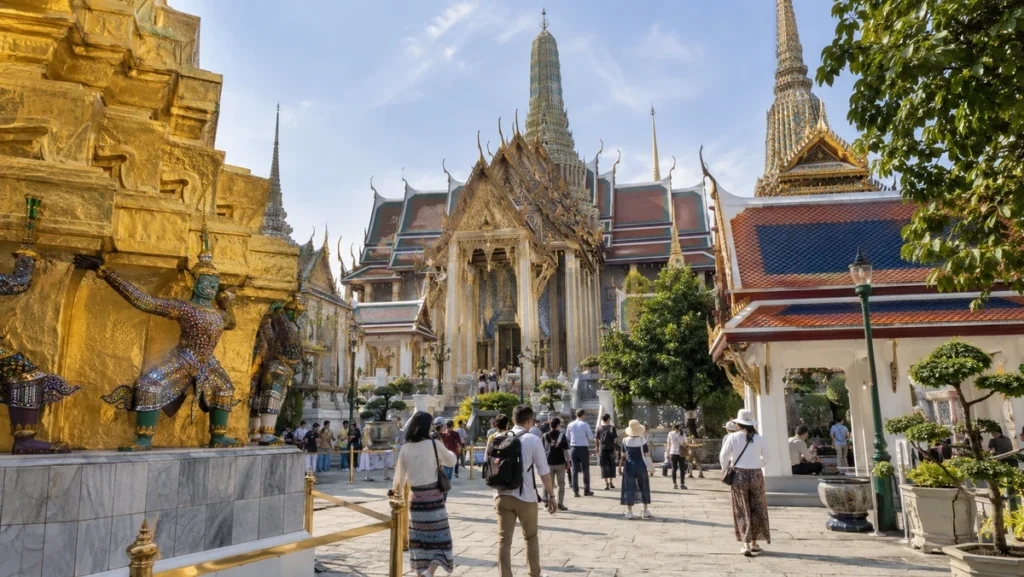
The Grand Palace and Wat Phra Kaew came first. I allowed roughly 2–2.5 hours, which gave me enough time to look properly without spending most of the day inside the complex.
Foreign admission has recently been around ฿500 (about US$15).
From there, I walked to Wat Pho, home to the Reclining Buddha. Admission has recently been around ฿300 (about US$9), and I found 75–90 minutes about right.
The Reclining Buddha gets most of the attention, but the quieter courtyards and chedis were the part I enjoyed more than expected.
Wat Arun was my final major stop. Crossing the Chao Phraya by boat was quicker and more enjoyable than taking a taxi around the river. Foreign admission has recently been roughly ฿200 (about US$6).
By late afternoon I was templed out. Adding another famous sight would have made the schedule look better on paper but the actual day worse.
For admission, meals, drinks, and local transportation, I would allow approximately ฿1,400–2,000 (US$42–61).
Day 3 — Markets, Neighborhoods and Chinatown
I kept the third Bangkok day looser.
If it falls on Saturday or Sunday, Chatuchak Weekend Market makes sense in the morning. I would rearrange the itinerary around the calendar rather than miss a weekend experience because a fixed schedule says something else belongs on Day 3.
On a weekday, I preferred spending more time along the Chao Phraya before heading to Yaowarat Road in Chinatown after dark.
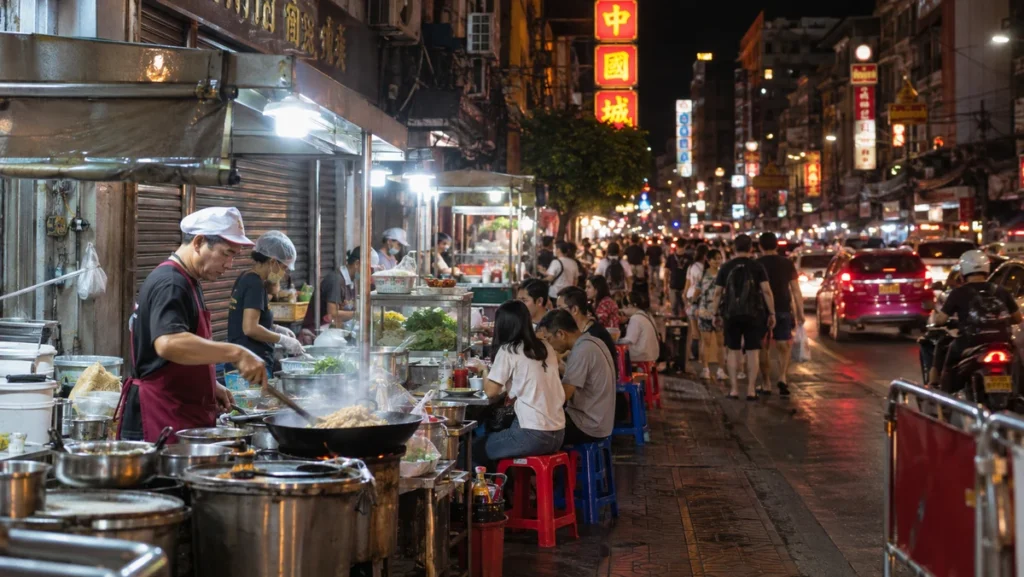
Chinatown was one of those places where the atmosphere mattered as much as any individual sight. Smoke drifted from grills beside slow traffic, woks clattered behind plastic tables, and queues formed in spaces that looked too narrow for another person.
Eating from several stalls cost roughly ฿300–600 (US$9–18).
Days 4–7: Chiang Mai and Northern Thailand
Day 4 — Bangkok to Chiang Mai
Flying made sense for a two-week trip.
The flight itself takes roughly 1 hour 15 minutes, but describing this as a one-hour transfer is misleading. Hotel checkout, travel to the airport, security, waiting, baggage collection, and the ride into Chiang Mai turned it into about a 4–5 hour door-to-door move.
Typical domestic fares can fall around ฿1,500–4,000 (US$46–121) depending on the airline, luggage, travel date, and booking time.
One small detail can cause a surprisingly big problem: BKK and DMK are different Bangkok airports. Suvarnabhumi is BKK; Don Mueang is DMK. I checked the airport code every time rather than assuming all Bangkok flights left from the same place.
After arriving in Chiang Mai, I stayed around the Old City and ate my first bowl of khao soi, the northern curry noodle dish I ended up ordering several times.
Day 5 — Wat Pha Lat and Doi Suthep
Wat Pha Lat and Wat Phra That Doi Suthep fit naturally into the same day because both sit west of central Chiang Mai.
Wat Pha Lat was quieter and greener than I expected. Doi Suthep had far more visitors, but the temple complex was still worth continuing uphill for.
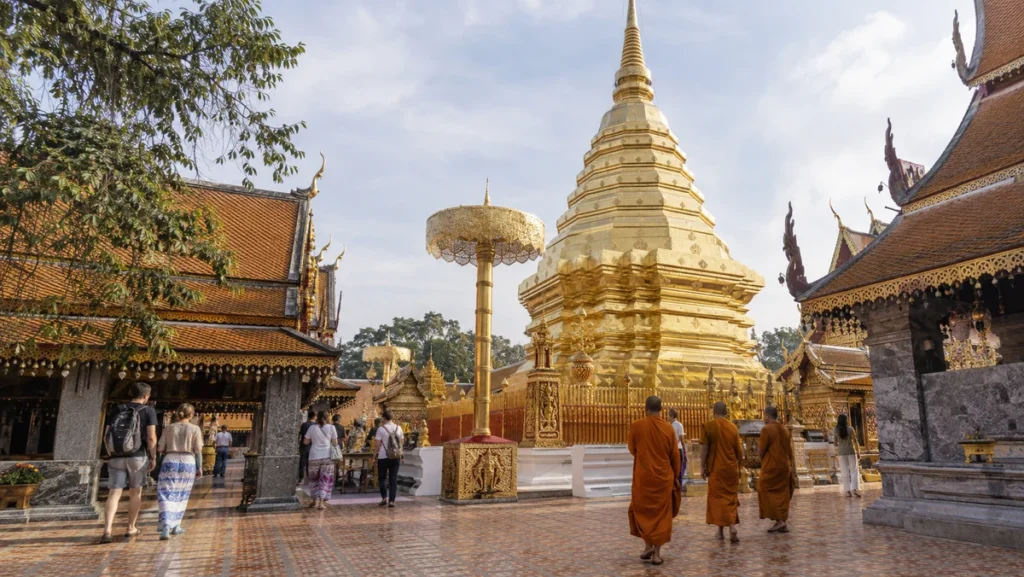
A shared songthaew keeps the outing relatively inexpensive. I would budget around ฿300–700 (US$9–21) for shared transport, modest temple costs or donations, water, and snacks.
A private driver or rideshare makes the day easier but can raise transport costs to roughly ฿800–1,500 (US$24–46) depending on waiting time and extra stops.
Later, I went to Nimman, which felt almost like a different version of Chiang Mai—more cafés and modern restaurants, fewer temple walls and old-city lanes.
Day 6 — Cooking Class and Old City
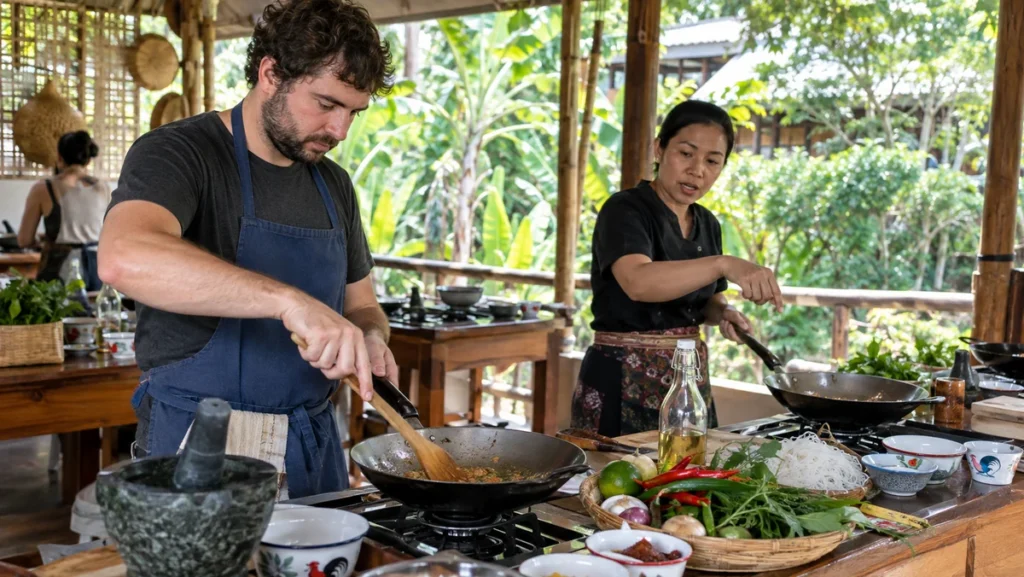
A Thai cooking class was one of the paid activities that felt worth the money.
Half-day group classes commonly cost around ฿1,000–1,500 (US$30–46) and often include ingredients, instruction, several dishes, and pickup from central accommodation.
I kept the second half of the day lighter: Wat Chedi Luang, Wat Phra Singh, coffee, and an evening market.
If the schedule puts this day on Sunday, I would make sure to be back around the Old City for the Sunday Walking Street rather than committing to another evening tour.
Day 7 — Elephants or Doi Inthanon
I used the final full northern day for one major excursion.
Travelers interested in elephants need to choose operators carefully. I avoided places advertising riding, tricks, shows, or obviously forced interactions.
More welfare-focused substantial half-day or full-day programs often cost roughly ฿2,500–3,500 (US$76–106) including transportation and usually a meal.
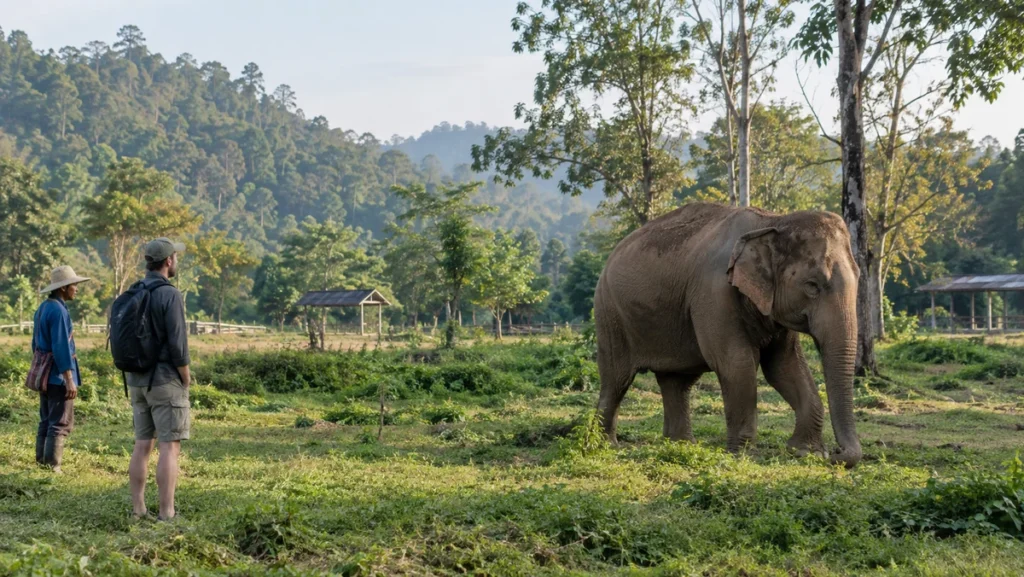
The alternative is Doi Inthanon National Park for mountain scenery, waterfalls, and walking. Organized trips generally cost around ฿1,200–2,200 (US$36–67) depending on group size and inclusions.
Trying to squeeze both experiences into one day would work against the whole point of keeping this itinerary manageable.
Days 8–12: Krabi, Ao Nang and Railay
Day 8 — Chiang Mai to Krabi
This was another transfer where the flight time told only half the story.
A nonstop Chiang Mai–Krabi flight takes roughly two hours, but I treated the move as about five hours door to door.
Fares vary considerably, so I would budget roughly ฿2,500–5,500 (US$76–167) with baggage.
From Krabi Airport, shared transfers to Ao Nang usually cost around ฿150–250 (US$5–8), while a private car commonly comes in around ฿500–800 (US$15–24).
I chose Ao Nang rather than Railay as my base.
Railay is more atmospheric, but Ao Nang made airport transfers, restaurants, ATMs, pharmacies, tour departures, and last-minute weather changes much easier. For a two-week itinerary, that convenience mattered more to me than waking directly beside Railay Beach.
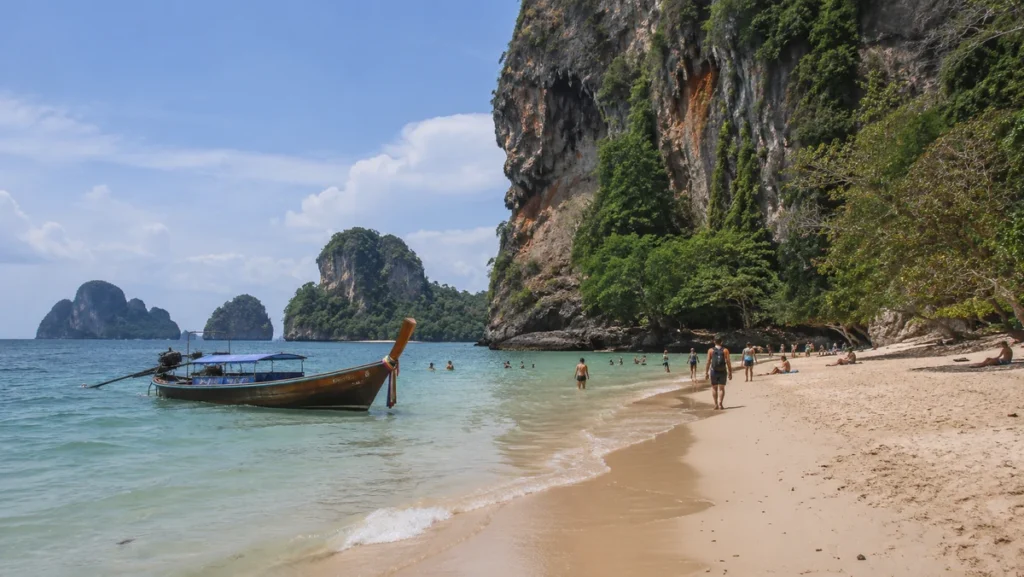
Day 9 — Railay and Phra Nang
I took a longtail boat to Railay in the morning.
Shared boats from Ao Nang generally cost roughly ฿100–200 each way (US$3–6) and take about 10–15 minutes in normal conditions.
Railay looks attached to the mainland on a map because it is, but limestone cliffs isolate it from the road network. Boats are the practical way in and out.
I walked between Railay West and Phra Nang Beach, stopped for lunch, swam, and stayed into the afternoon.
Sandals were useful because boat landings sometimes meant stepping directly into shallow water.
A relaxed day cost roughly ฿500–1,000 (US$15–30) including boats, food, and drinks.
Day 10 — Hong Islands
For my main island excursion, I chose the Hong Islands.
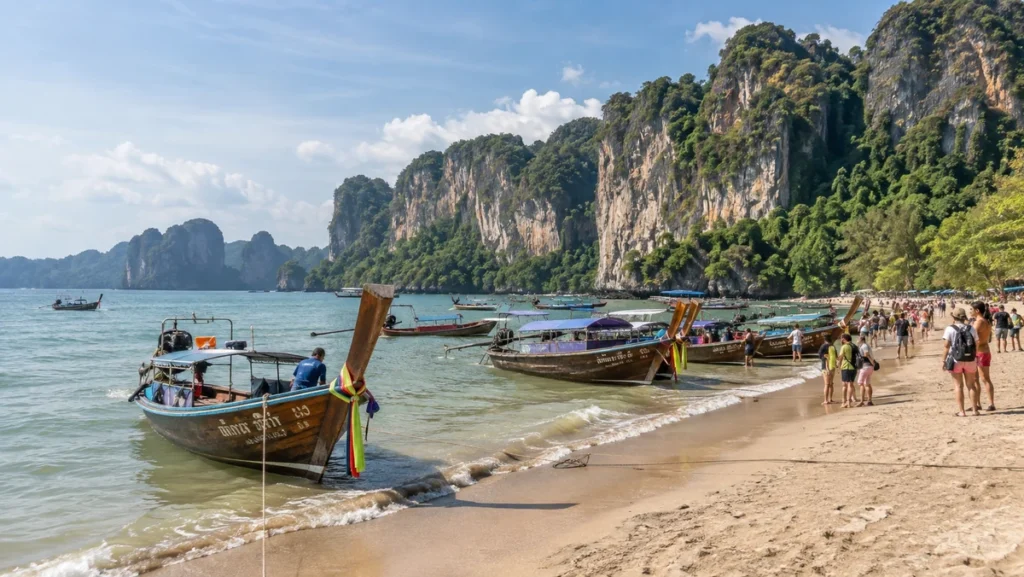
Shared longtail or speedboat trips generally cost roughly ฿1,500–2,500 (US$46–76) per person after common inclusions and applicable park fees. The final price depends on the boat type, pickup, lunch, and whether fees are bundled into the advertised rate.
This was one place where paying a little more for a well-run boat trip felt worthwhile.
Southern Thailand looked exactly as dramatic as I had hoped: limestone walls rising from blue-green water, small beaches tucked between cliffs, and stretches that felt much quieter once the boats spread out.
Day 11 — Tiger Cave Temple and a Slower Afternoon
After several days of flights and boats, I did not want another full excursion.
Tiger Cave Temple gave me something completely different. The climb to the summit involves more than a thousand steep steps, and the heat made it substantially harder than the distance suggested.
I allowed 3–4 hours including transport, breaks, and the climb.
A practical budget of ฿500–1,000 (US$15–30) covered local transport, drinks, food, and incidental costs.
The rest of the afternoon went to a massage and an unhurried evening around Ao Nang.
Day 12 — The Weather-Buffer Day
This ended up being one of the smartest days in the itinerary because I had not committed it to anything.
With good sea conditions, I could book another island excursion. A shared Four Islands tour commonly costs around ฿1,200–2,000 (US$36–61) once typical inclusions and fees are considered.
If the weather was poor, Krabi Town, cafés, a massage, or a slow beach afternoon gave me alternatives without losing money on another prepaid boat trip.
A flexible day is more useful on the coast than an itinerary that assumes the sea will cooperate every morning.
Day 13 — Back to Bangkok
I flew back to Bangkok one day before my international departure.
That meant sacrificing a possible extra beach night, but it removed one of the biggest avoidable risks in the trip.
Flights from Krabi to Bangkok commonly fall around ฿1,500–4,000 (US$46–121) depending on the airline, baggage, and travel date.
Again, I checked the airport.
If an international flight leaves from BKK, paying slightly more for a domestic flight into BKK can make more sense than landing at DMK and crossing Bangkok simply to save a few dollars.
The evening became a final Thai dinner rather than another sightseeing session.
Day 14 — Departure
I left departure day clear.
For a long-haul international flight, I preferred getting to the airport roughly three hours before departure rather than squeezing another attraction into the morning.
Bangkok traffic was unpredictable enough that one final temple was not worth gambling an expensive flight home.
Flight or Sleeper Train to Chiang Mai
Flying is not the only sensible way north.
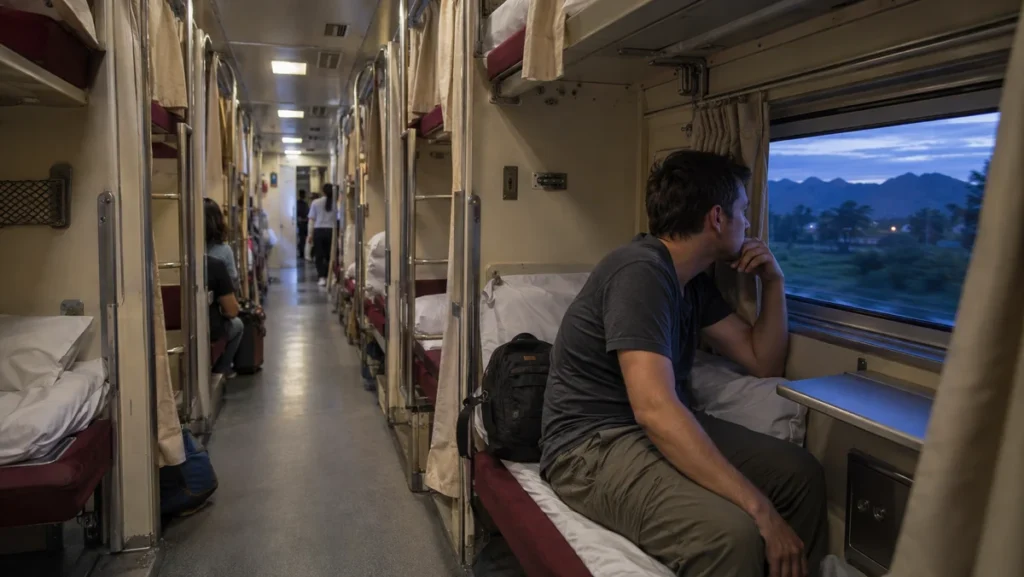
An overnight sleeper train between Bangkok and Chiang Mai takes roughly 12–14 hours depending on the service, but most of the journey happens while you would otherwise be sleeping.
| Option | Journey Time | Real Planning Time | Estimated Cost | Best For |
|---|---|---|---|---|
| Flight | About 1h 15m | 4–5 hours door to door | ฿1,500–4,000 | Travelers prioritizing time |
| Sleeper train | Roughly 12–14 hours | Overnight | ฿900–1,700 | Experience and saving a hotel night |
| Day train | Roughly 11–14 hours | Most of a day | ฿300–1,000 | Tight budgets with more time |
For this route, I preferred flying.
If taking the train, I would choose the sleeper rather than give up almost an entire sightseeing day.
The Best Areas to Stay on This Route
| Destination | Area | Best For | Typical Nightly Cost | My Take |
|---|---|---|---|---|
| Bangkok | Silom/Sathorn | BTS/MRT access and dining | ฿1,800–4,500 (US$55–136) | Best all-round balance |
| Bangkok | Old City | Grand Palace and temples | ฿1,200–3,000 (US$36–91) | Excellent sightseeing location, weaker rail links |
| Chiang Mai | Old City | Temples, markets and walking | ฿1,000–3,000 (US$30–91) | My choice for a first trip |
| Chiang Mai | Nimman | Cafés, nightlife and modern hotels | ฿1,300–3,500 (US$39–106) | Better if Old City atmosphere matters less |
| Krabi | Ao Nang | Boats, tours, restaurants and transfers | ฿1,200–3,500 (US$36–106) | Most practical southern base |
| Krabi | Railay | Beach setting and limestone scenery | ฿2,500–6,000+ (US$76–182+) | More atmospheric but less convenient |
| Bangkok | BKK airport area | Early international departures | ฿1,300–3,000 (US$39–91) | Useful for a very early flight |
Hotel prices can climb sharply around Christmas, New Year, Songkran, and other busy periods.
For this itinerary, I cared more about location than luxury. Saving a few hundred baht on a room did not make sense if it meant paying for extra taxis every day.
A Realistic Budget for 14 Days in Thailand
For easy planning, I used roughly ฿33 to US$1 for the dollar estimates below. Exchange rates move, so the USD figures are deliberately rounded.
International flights to and from Thailand are not included.
| Travel Style | Accommodation | Food | Transport | Activities & Extras | 14-Day Estimate |
|---|---|---|---|---|---|
| Budget | ฿11,000–16,000 | ฿7,000–10,000 | ฿10,000–14,000 | ฿10,000–12,000 | ฿38,000–52,000 (US$1,150–1,575) |
| Mid-range | ฿24,000–36,000 | ฿12,000–18,000 | ฿14,000–18,000 | ฿10,000–13,000 | ฿60,000–85,000 (US$1,820–2,575) |
| Comfortable | ฿50,000–75,000 | ฿20,000–30,000 | ฿18,000–25,000 | ฿12,000–15,000 | ฿100,000–145,000 (US$3,030–4,395) |
For a mid-range couple sharing one room, I would allow roughly ฿95,000–130,000 combined (US$2,880–3,940) excluding long-haul flights.
Food and accommodation were the easiest places to control costs.
The places where spending extra made more sense were:
- Direct domestic flights
- Hotels close to useful transport
- Reliable boat operators
- Private airport transfers when flight times were awkward
- A good small-group experience rather than the cheapest mass-market tour
On a 14-day trip, saving $20 on transport did not feel like a bargain if it cost me another half-day.
Places I Left Out on Purpose
Phuket
I did not need both Phuket and Krabi.
Phuket has stronger flight connectivity, more nightlife, larger resorts, and a broader tourism infrastructure. Krabi gave me the limestone scenery, Railay access, and island trips I wanted.
Visiting both would have created another hotel checkout and another transfer day.
For this route, I picked Krabi.
Koh Phi Phi
Phi Phi made more sense to me as an optional excursion than another overnight stop.
Travelers who specifically want early-morning boat access or evenings on Phi Phi Don may prefer staying there, but I valued having fewer hotel changes.
Chiang Rai
Chiang Rai deserved more time than the rushed day trip I could give it.
The White Temple, Blue Temple, and Baan Dam were tempting, but adding Chiang Rai meant either cutting Chiang Mai short or creating another overnight move.
I saved it for a longer northern Thailand trip.
Pai
Pai meant another long, winding road transfer each way.
Fourteen days already contained enough movement, so I left it out rather than spending more of the trip reaching destinations.
Khao Sok
This was the hardest omission.
If jungle, wildlife, and lake scenery matter more than multiple beach days, Khao Sok is the swap I would make.
I would take two nights from Ao Nang and spend them in Khao Sok rather than adding the national park on top of everything else.
Ayutthaya
Ayutthaya works well as a Bangkok day trip, but I would use it instead of Day 3, not add another excursion to an already full schedule.
A good two-week itinerary is partly about deciding what not to include.
The Order I’d Book the Trip
After working through the route, this order made the most sense:
- Book the international flights.
- Choose the southern coast based on the travel month.
- Check Chiang Mai-to-south flights before fixing every hotel date.
- Book accommodation in the three main bases.
- Reserve a sleeper train early if using one instead of flying.
- Book high-priority activities such as a cooking class or responsible elephant experience.
- Keep ordinary island tours flexible unless traveling during a peak holiday period.
- Keep the final night close enough to the international departure airport to remove unnecessary risk.
The third step was the one I initially underestimated.
A good direct connection between northern and southern Thailand can determine whether the route flows naturally or wastes most of a day.
Common Mistakes I’d Avoid
Trying to visit both the Gulf and Andaman coasts. Two weeks is too short for most travelers to justify crossing southern Thailand simply to collect more islands.
Counting flight time instead of transfer time. A 90-minute domestic flight can easily consume four or five hours door to door.
Ignoring BKK versus DMK. Bangkok’s two major airports are not interchangeable terminals.
Treating arrival day as a full sightseeing day. After a long-haul flight, a simple evening was a much better start.
Booking every island day months ahead. A flexible weather day can be more valuable than another prepaid excursion.
Leaving an island on the same day as an expensive international flight. The extra beach hours were not worth that risk to me.
Adding Chiang Rai as a casual Chiang Mai side trip. It deserves proper time or another visit.
Changing hotels every two nights. Thailand did not become more interesting just because I added more pins to the map.
Quick Answers for Planning Two Weeks in Thailand
Is 14 days enough for Thailand?
Yes. Fourteen days was enough for me to combine Bangkok, Chiang Mai, and one southern beach region at a comfortable pace.
It is not enough to cover every major destination without turning the trip into a checklist. Three main bases felt about right.
Phuket or Krabi for a first two-week trip?
I preferred Krabi for Railay, limestone scenery, and straightforward island trips.
Phuket makes more sense if nightlife, large resorts, wider flight options, and more developed beach infrastructure matter more.
For two weeks, I would choose one rather than spend valuable time doing both.
Is Chiang Mai worth including in two weeks?
For most first trips, yes.
Four nights gave me northern food, temples, mountains, markets, and a completely different atmosphere from Bangkok and the islands.
During severe smoke season, however, I would be comfortable skipping it and moving those nights south.
How much money do I need for two weeks in Thailand?
Excluding international airfare, I would plan around ฿60,000–85,000 (roughly US$1,820–2,575) per person for the mid-range travel style used in this itinerary.
A budget-focused trip can cost considerably less, while upscale resorts, private tours, premium restaurants, and frequent private transfers can push the total much higher.
Final Thoughts
The biggest improvement I made to this trip was not adding another destination. It was removing them.
Three nights in Bangkok gave me time to recover and explore properly. Four nights in Chiang Mai made northern Thailand feel like a real part of the journey. Five nights around Krabi gave me room for Railay, island trips, bad-weather flexibility, and an afternoon when I did not need to be anywhere.
If I planned the same 14 days in Thailand again, I still would not force Phuket, Pai, Chiang Rai, Koh Samui, and another island into the same trip.
The route worked because I stopped asking how much I could fit into two weeks and started asking how much I could actually enjoy.